The Ultimate Kettlebell HIIT Workout for Full-Body Strength
By Simple HIIT Timer Team · October 9, 2026
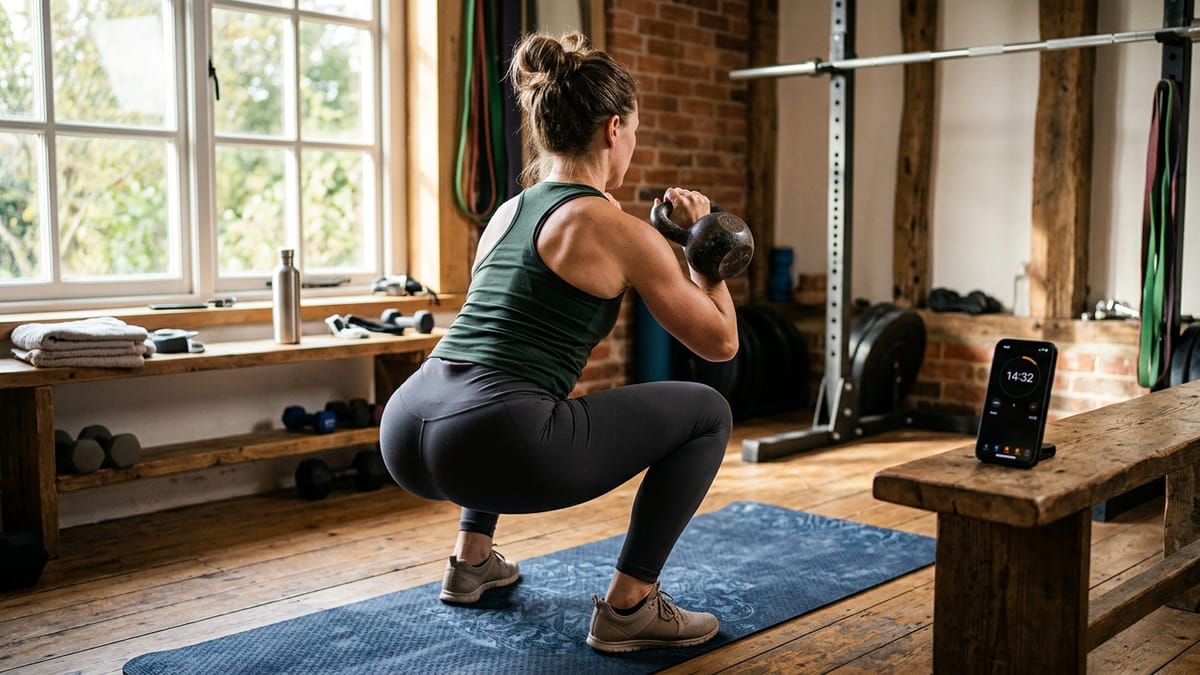
When you want to build strength, increase power, and elevate your heart rate all at once, few tools rival the kettlebell. Unlike traditional dumbbells that evenly distribute weight in your hand, a kettlebell has a displaced center of mass. This unique design forces your core and stabilizing muscles to work overtime just to control the bell. When you combine this dynamic resistance with high-intensity interval training, you get a kettlebell HIIT workout that delivers comprehensive fitness results in a fraction of the time.
This guide will walk you through a complete, full-body kettlebell interval routine. Whether you are training in your garage, your living room, or a commercial gym, all you need is a single piece of equipment and a reliable interval timer. We will cover how to select your weight, how to warm up safely, and how to execute each movement with proper form to maximize your results while minimizing the risk of injury.
Why Combine Kettlebells with Interval Training?
Interval training involves alternating periods of intense effort with periods of rest or lower-intensity recovery. This method is famous for improving cardiovascular capacity and increasing the number of calories you burn both during and after your session—a concept known as excess post-exercise oxygen consumption. By introducing a kettlebell into the mix, you transform a standard cardio session into a robust strength-building workout.
Kettlebell exercises are inherently ballistic and functional. Movements like the swing or the push press require you to generate power from your legs and hips, transfer it through a rigid core, and express it through your upper body. This mimics how we move in real life and sports. Utilizing an online interval timer to dictate your work and rest periods keeps you accountable, ensuring you maintain a high level of intensity without letting your rest breaks drag on for too long.
Choosing the Right Kettlebell Weight
Selecting the correct weight is crucial for both safety and effectiveness. If the bell is too light, you will not stimulate enough muscle growth or elevate your heart rate sufficiently. If it is too heavy, your form will break down, significantly increasing your risk of injury.
If you are a beginner, it is highly recommended to start lighter until you master the fundamental hip hinge and racking positions. A standard starting weight for women learning kettlebell movements is generally between 8 kg (18 lbs) and 12 kg (26 lbs). For men, a starting weight typically falls between 16 kg (35 lbs) and 20 kg (44 lbs). Because lower body exercises like swings and squats utilize large, powerful muscle groups, you will eventually find that you can handle a much heavier bell for those movements compared to upper body exercises like overhead presses.
The Essential Warm-Up
Never skip your warm-up, especially before a kettlebell HIIT workout. Kettlebell training demands highly mobile hips, shoulders, and ankles, as well as a primed central nervous system. Spend five to ten minutes moving through the following bodyweight and mobility exercises before you pick up the bell:
- Arm Circles and Shoulder Dislocates: Use a resistance band or a broomstick to gently mobilize the shoulder joints.
- Bodyweight Squats: Perform 15 to 20 slow squats, focusing on pushing your knees outward and keeping your chest proud.
- Hip Hinges: Stand tall, place your hands on your hips, and push your glutes backward while keeping your shins vertical. This pattern is the foundation of the kettlebell swing.
- Plank Walkouts: Start from a standing position, hinge at the hips, place your hands on the floor, and walk them out into a high plank position. Hold for two seconds, brace your core, and walk your hands back to your feet. Repeat 5 times.
The 20-Minute Kettlebell HIIT Routine
This routine is built around a work-to-rest ratio of 45 seconds of work followed by 15 seconds of rest. This is a demanding protocol that challenges your muscular endurance and aerobic capacity. You will perform five distinct exercises back-to-back. Completing all five exercises constitutes one round, which takes five minutes. To complete the 20-minute workout, you will perform four total rounds.
For this routine, we will be using the workout timer online preset specifically designed for a 45-second on, 15-second off structure. Once you start the timer, you will hear a beep when it is time to work and another beep when it is time to rest, allowing you to focus entirely on your form rather than watching the clock.
Exercise 1: Two-Handed Kettlebell Swing
The kettlebell swing is the king of ballistic exercises, targeting your glutes, hamstrings, and core. Stand with your feet shoulder-width apart, with the kettlebell on the floor about a foot in front of you. Hinge at the hips and grip the handle with both hands. Tilt the bell toward you, then explosively hike it backward between your legs like a football. Immediately thrust your hips forward, squeezing your glutes and bracing your abs. The power from your hips should propel the bell forward and upward to chest height. Let gravity pull the bell back down, guiding it back between your legs to initiate the next rep. Remember, this is a hip hinge, not a squat. Your arms are merely ropes holding the bell; your lower body does the work.
Exercise 2: Goblet Squat
After your 15-second rest, transition to the goblet squat to target your quads, core, and upper back. Clean the kettlebell up to your chest, holding it by the "horns" (the vertical sides of the handle). Keep your elbows tucked in tight to your ribs and the bell resting lightly against your chest. Brace your core, push your hips back, and lower yourself into a squat. Aim to get your hip crease below your knee joint if your mobility allows, while keeping your chest lifted and your heels firmly planted on the floor. Drive through your mid-foot to stand back up, fully extending your hips at the top.
Exercise 3: Alternating Bent-Over RowsNext, we move to the upper back and biceps. Stand with your feet slightly wider than shoulder-width apart. Hinge forward at the hips until your torso is nearly parallel to the floor, keeping a neutral spine. The kettlebell should be on the floor between your feet. Grab the handle with your right hand, brace your core to prevent your torso from twisting, and pull the bell up toward your right hip. Squeeze your shoulder blade at the top, then lower the bell to the floor in a controlled manner. Switch hands and repeat on the left side. Continue alternating sides for the full 45 seconds.
Exercise 4: Push Press (Alternate Arms Per Round)
The push press builds shoulder strength and total-body coordination. Clean the kettlebell to the rack position on your right side. In the rack position, the bell should rest on the back of your forearm, tucked into the V-shape created by your bicep and forearm, with your elbow resting against your ribcage. Dip your knees slightly, then explosively drive your legs upward. Use this momentum from your lower body to help punch the kettlebell straight overhead until your arm is fully locked out. Slowly lower the bell back to the rack position. Stay on your right arm for the entire 45 seconds during round one. In round two, perform the push press on your left arm. Alternate arms for the remaining rounds.
Exercise 5: Kettlebell Plank Pull-Throughs
Finish the circuit with a brutal core exercise. Set the kettlebell on the floor and get into a high plank position with the bell sitting just outside your right hand. Your feet should be wider than usual to prevent your hips from shifting. Reach your left hand underneath your body, grab the kettlebell handle, and drag it across the floor to the left side of your body. Place your left hand back down on the floor, then reach under with your right hand and drag the bell back to the right side. The goal is to keep your hips completely parallel to the floor while moving the weight.
Common Mistakes to Avoid
When performing high-intensity intervals, fatigue can cause your form to deteriorate. Keep these common mistakes in mind so you can correct them in real-time:
- Squatting the Swing: As mentioned, the swing is a horizontal movement driven by the hips, not a vertical movement driven by the knees. If your quads are burning more than your glutes and hamstrings, you are likely squatting the movement.
- Losing a Neutral Spine: Whether you are swinging, rowing, or pulling the bell through from a plank, your back must remain flat and your core engaged. Rounding your lower back places excessive stress on your lumbar spine.
- Over-Gripping the Handle: Gripping the kettlebell too tightly will quickly exhaust your forearms and can lead to torn calluses. Hold the bell securely, but let it rotate smoothly within your grip during swings and cleans.
Modifying and Progressing Your Workout
One of the best things about kettlebell training is how easily it scales to your current fitness level. If 45 seconds of work feels too daunting, you do not have to abandon the routine. Instead, adjust your work-to-rest ratio. You can use an interval timer online set to a beginner-friendly 30 seconds of work and 30 seconds of rest. This provides ample time to catch your breath and reset your posture before the next set.
Conversely, if you are an experienced lifter and want to push your limits, you can increase the intensity without buying a heavier kettlebell. Simply reduce your rest periods. Try setting your timer to 50 seconds of work and only 10 seconds of rest. This drastically increases the time under tension and demands rapid cardiovascular recovery between movements.
Cooldown and Recovery
When the final buzzer sounds, resist the urge to immediately collapse on the floor. Your heart rate is elevated, and you need to bring it down gradually to avoid dizziness and promote recovery. Spend three to five minutes walking slowly around your workout space, taking deep, controlled breaths in through your nose and out through your mouth.
Once your breathing has normalized, move into some static stretches. Focus on stretching the muscle groups that did the most work: the hip flexors, hamstrings, lats, and shoulders. Proper hydration and adequate protein intake in the hours following your workout will ensure your muscles have the nutrients they need to repair and grow stronger before your next kettlebell session.
Frequently asked questions
Can I do a kettlebell HIIT workout every day?
It is generally not recommended to perform high-intensity kettlebell workouts every day. Your muscles and central nervous system require time to recover, so aim for three to four sessions per week with rest or active recovery days in between.
What size kettlebell should a beginner start with?
For most beginners, a 16 kg (35 lb) bell is typically recommended for men, and an 8 kg (18 lb) to 12 kg (26 lb) bell is recommended for women. It is always better to start lighter to master proper movement mechanics before increasing the weight.
Are kettlebell swings considered cardio or strength training?
Kettlebell swings are a highly effective hybrid exercise that provides both cardiovascular and strength benefits. The explosive hip hinge builds significant power in the glutes and hamstrings, while the continuous movement heavily taxes your aerobic system.
Can I lose weight with kettlebell interval training?
Yes, kettlebell intervals burn a substantial amount of calories and can support fat loss when combined with a balanced, healthy diet. The high-intensity nature of the workout also keeps your metabolism elevated long after you finish training.
Use this timer
Start the 45s on / 15s off timer — 45s work / 15s rest × 10 rounds. It runs in your browser with sound cues, and there is nothing to install.