How to Recreate Studio-Style Interval Workouts at Home
By Simple HIIT Timer Team · October 20, 2026
With recent news of major boutique fitness studios closing locations or changing their class structures, many people are looking for ways to maintain their training routines without the hefty membership fees. The good news is that the magic of a premium group fitness class is not the ambient lighting or the loud music. The real secret is the structured programming.
By combining cardiovascular intervals with strength blocks and tracking your work with a free interval timer, you can replicate these highly effective workouts in your garage, living room, or local commercial gym. You do not need thousands of dollars in commercial equipment to build work capacity, burn calories, and increase your muscular endurance.
The Anatomy of a Studio Workout
Most popular boutique fitness classes follow a predictable, highly effective formula: the 50/50 split. Half of your time is spent on cardiovascular conditioning, and the other half is dedicated to resistance training on the floor.
This structure works because it utilizes concurrent training. You push your heart rate near its maximum during the cardio blocks, then allow it to recover slightly while you challenge your muscular endurance during the strength blocks. The constant shifting prevents localized muscle fatigue from ending your workout prematurely, allowing you to sustain a high work output for 45 to 60 minutes.
The Role of Time-Based Sets
Traditional weightlifting relies on rep counts, but studio classes rely on the clock. Time-based intervals force you to maintain a consistent pace and eliminate the temptation to rest too long between sets. A typical circuit might ask you to work for 60 seconds and transition for 20 seconds. This specific work-to-rest ratio provides just enough time to switch equipment or catch your breath, but not enough time for your heart rate to drop back to baseline.
Setting Up Your Space
To run a successful studio-style routine at home, you need to set up two distinct stations before you start the clock.
- The Cardio Station: If you have a treadmill, stationary bike, or rowing machine, this is your primary cardio engine. If you do not have heavy equipment, clear a small area for bodyweight cardio movements like jump rope, high knees, mountain climbers, or burpees.
- The Floor Station: You will need a yoga mat and resistance equipment. A single pair of medium-weight dumbbells is often enough. If you do not have dumbbells, kettlebells or resistance bands are excellent substitutes.
The 45-Minute Studio-Style Blueprint
This routine is broken into four distinct blocks: a warm-up, a cardio endurance block, a strength circuit, and a final power block. Set your timer before you begin so you do not have to touch your phone during the workout.
Block 1: Dynamic Warm-Up (5 Minutes)
Never skip the warm-up, especially before high-intensity intervals. Spend one minute on each of the following movements to prepare your joints and elevate your core temperature.
- Jumping Jacks: Light and easy, staying on the balls of your feet.
- Bodyweight Squats: Focus on depth and keeping your chest up.
- Walkouts to Plank: Hinge at the hips, walk your hands out to a high plank, and walk back.
- Alternating Reverse Lunges: Keep your front knee tracking over your toes.
- Arm Circles and Torso Twists: Open up the shoulders and thoracic spine.
Block 2: Cardio Endurance (10 Minutes)
This block builds sustained aerobic capacity. If you are on a treadmill, bike, or rower, use the guidelines below. If you are doing bodyweight cardio, alternate between two minutes of jumping rope and one minute of fast mountain climbers.
| Time | Pace / Intensity | Description |
|---|---|---|
| Minutes 0:00 - 3:00 | Base Pace | A challenging but doable pace. You should be able to speak in short sentences. |
| Minutes 3:00 - 5:00 | Push Pace | Uncomfortable. You should be breathing heavily and unable to hold a conversation. |
| Minutes 5:00 - 6:00 | Base Pace | Active recovery. Bring your heart rate down slightly but keep moving. |
| Minutes 6:00 - 9:00 | Push Pace | Return to the uncomfortable pace. Try to match your previous speed or wattage. |
| Minutes 9:00 - 10:00 | All-Out Effort | Maximum effort. Empty the tank before transitioning to the floor block. |
Block 3: Strength Circuit (15 Minutes)
Transition to your floor station. For this block, use a circuit timer set to 60 seconds of work and 20 seconds of rest. You will complete three rounds of the following five exercises. Focus on form over speed.
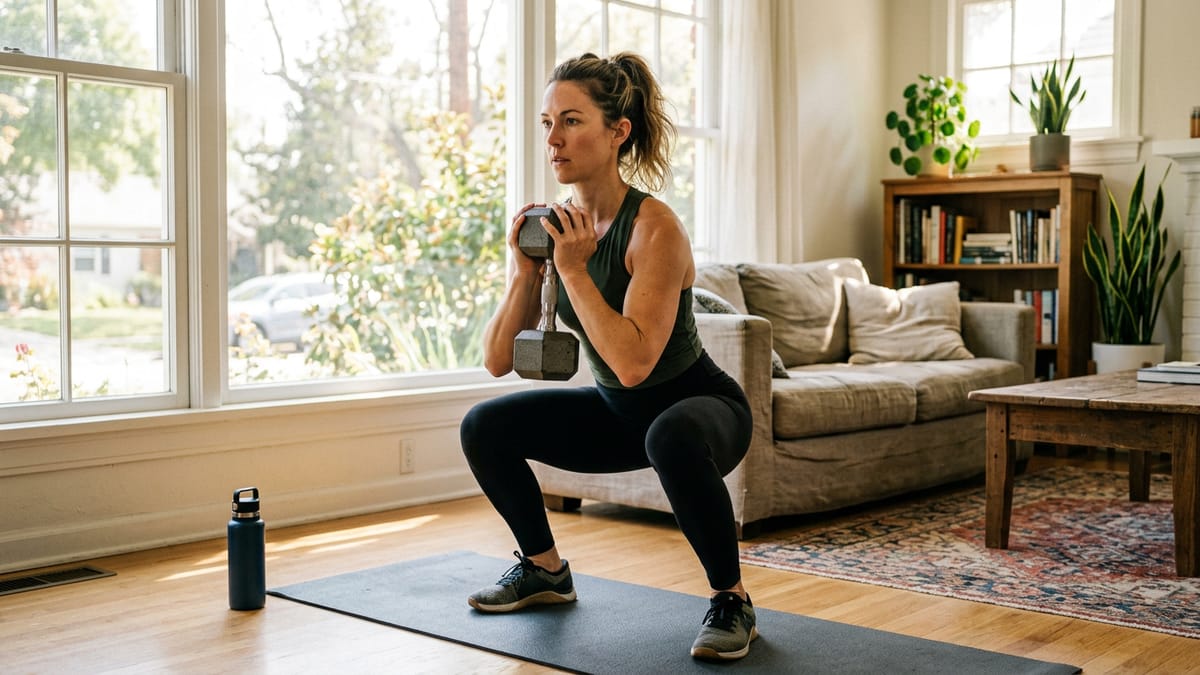
- Dumbbell Goblet Squats: Hold one dumbbell vertically against your chest. Squat down until your hips are below your knees, then drive through your heels to stand.
- Alternating Renegade Rows: Start in a high plank position with your hands gripping the dumbbells. Row one weight to your hip while keeping your hips square to the floor. Alternate sides.
- Reverse Lunges with Bicep Curl: Step back into a lunge. As you lower your back knee toward the floor, curl the dumbbells to your shoulders. Lower the weights as you step back to the starting position.
- Floor Presses: Lie on your back with your knees bent. Press the dumbbells straight up over your chest, then lower them until your triceps gently tap the floor.
- Hollow Body Hold: Lie on your back, press your lower back firmly into the mat, and lift your legs and shoulders slightly off the ground. Hold this static position for the full 60 seconds.
Block 4: Power Cardio Finisher (10 Minutes)
Return to your cardio station. This block focuses on short, explosive bursts of energy. We will use a 30-seconds-on, 30-seconds-off structure. You will complete 10 rounds total.
| Interval | Action | Intensity |
|---|---|---|
| 30 Seconds | Sprint or Max Effort Cardio | 100% effort. Push as hard as you safely can. |
| 30 Seconds | Complete Rest | Stand or walk slowly. Focus on taking deep, controlled breaths. |
Detailed Movement Breakdown
Executing floor exercises with proper technique is vital when you are working against the clock. Fatigue can quickly lead to form breakdown, which increases injury risk.
Renegade Rows: The most common mistake here is rotating the hips. To prevent this, widen your foot stance. The wider your feet, the more stable your base. If you still find your hips twisting, drop to your knees or perform the rows without weights until your core strength improves.
Goblet Squats: Keep your elbows tucked in close to your ribcage. If your heels lift off the floor at the bottom of the squat, your ankle mobility might be restricted. Try elevating your heels slightly on a small weight plate or rolled-up towel, and focus on pushing your knees outward as you descend.
Hollow Body Hold: If your lower back arches off the floor, you are losing core engagement and putting stress on your spine. To scale this movement, bend your knees to 90 degrees or reach your arms forward instead of overhead. The non-negotiable rule is that your lower back must remain glued to the mat.
Adapting for Your Fitness Level
One of the greatest benefits of running your own timer is that you control the scaling. In a commercial studio, the instructor sets the pace. At home, you can adjust the variables to match your current fitness level.
If you are a beginner, change the floor circuit intervals to 40 seconds of work and 40 seconds of rest. This gives you more time to recover and ensures your form stays crisp. You can also reduce the weight of your dumbbells or perform the exercises using strictly bodyweight.
If you are an advanced athlete, increase the complexity of the movements. Turn the goblet squat into a thruster by pressing the dumbbell overhead as you stand. Swap the floor press for a loaded push-up. Increase the incline on your treadmill during the push paces to challenge your posterior chain.
Safety and Recovery Considerations
High-intensity interval training places significant stress on the central nervous system and the musculoskeletal system. Always consult with a healthcare provider before beginning a new exercise program, especially if you have pre-existing medical conditions, injuries, or are pregnant.
Do not perform this style of workout every single day. Your body needs time to repair muscle tissue and replenish glycogen stores. Aim for two to three studio-style workouts per week, interspersed with lower-intensity activities like walking, yoga, or traditional steady-state weightlifting.
Hydration and nutrition are foundational to recovery. Drink plenty of water before, during, and after your training session. Consuming an adequate amount of dietary protein will help repair muscle fibers damaged during the strength blocks, while complex carbohydrates will fuel your cardio intervals.
When you take control of your programming and use reliable tools to manage your time, you no longer need to rely on expensive studio memberships to achieve a high level of fitness. Clear your space, set your clock, and put in the work.
Frequently asked questions
Can I do studio-style workouts without a treadmill?
Yes. You can substitute treadmill intervals with jump rope, high knees, outdoor running, or a stationary bike. The key is matching the work and rest times to keep your heart rate elevated.
How heavy should my dumbbells be for circuit training?
Choose a weight that feels challenging by the last 10 seconds of a 60-second work period. Having one medium pair and one heavy pair allows you to scale upper and lower body exercises appropriately.
How many times a week should I do high-intensity interval circuits?
Two to three times per week is ideal for most people. This frequency allows your body to recover properly, especially when paired with low-intensity steady-state cardio or active recovery days.
Use this timer
Start the 60s station / 20s move timer — 60s work / 20s rest × 10 rounds. It runs in your browser with sound cues, and there is nothing to install.