The Adult Presidential Fitness Test: A 4-Week Training Guide
By Simple HIIT Timer Team · October 2, 2026
With recent federal initiatives and multi-million dollar innovation challenges launching to revive the Presidential Fitness Test in schools, benchmark testing is back in the national spotlight. The effort to encourage students to meet baseline physical standards is a fantastic step for public health. But assessing your physical baseline should not stop when you graduate. Setting up an adult version of a fitness test gives your workouts structure, measurable goals, and a clear picture of your overall functional capacity.
The Philosophy of Benchmark Testing for Adults
The concept of a standard fitness test is simple: you perform specific exercises under strict conditions to measure your strength, endurance, and agility. This provides a snapshot of your physical capabilities at a single point in time. When you transition from exercising just to burn calories to training for a specific benchmark, your intensity and focus naturally improve. You are no longer just going through the motions; you are training with a distinct purpose.
For adults, a fitness test is less about comparing yourself to national percentiles and more about competing against your past self. It highlights muscle imbalances, exposes drops in cardiovascular endurance, and reveals exactly where your training program might be lacking. If you can easily squat your body weight but struggle to complete a 60-second plank, your benchmark test just wrote your programming for the next month: it is time to focus on core stability.
Defining the Adult Fitness Test: The 5 Core Events
The classic schoolyard test featured events like the V-sit reach, shuttle run, and flexed-arm hang. For a practical adult fitness test, we need to adapt these movements to reflect functional, everyday strength and cardiovascular health. You do not need a gymnasium or specialized equipment to test yourself. Here are the five core events that make up a well-rounded adult fitness assessment.
Event 1: The 60-Second Push-Up Test
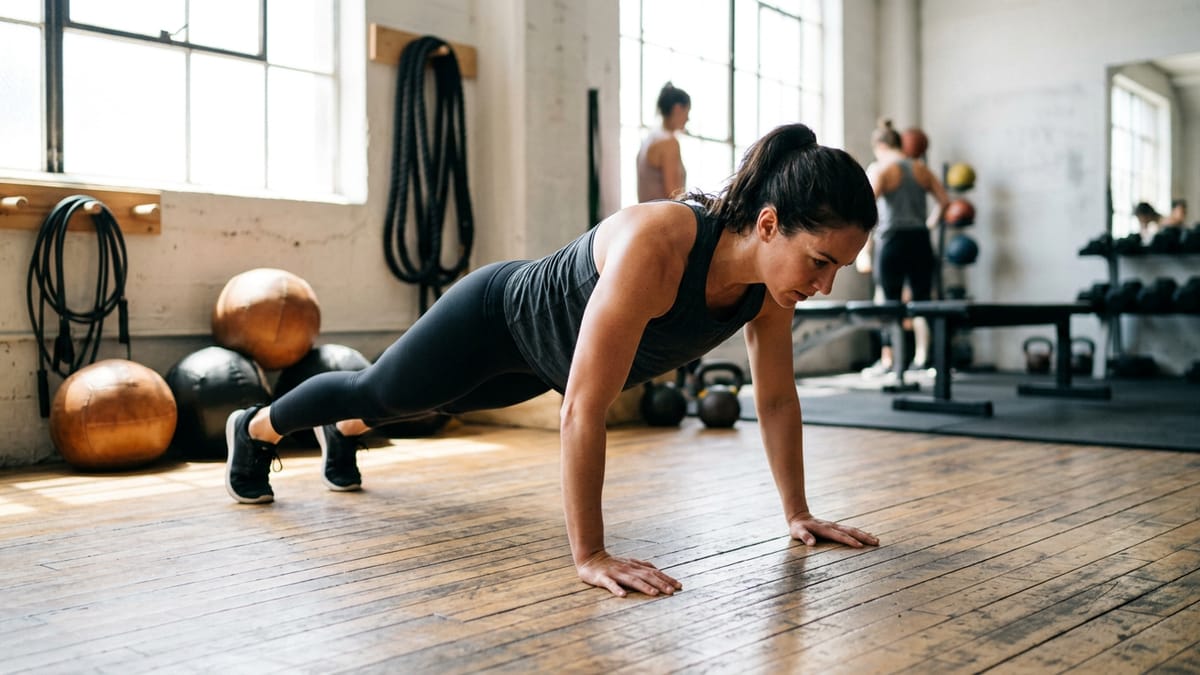
This event measures upper body pushing strength and muscular endurance. Set a timer for 60 seconds and complete as many strict push-ups as possible. Your chest must lower to just above the floor, and your elbows must fully lock out at the top of every repetition. If you need to rest, you can pause in the top plank position, but you cannot let your knees touch the ground. If standard push-ups are too difficult, perform this test with your hands elevated on a stable bench or chair, maintaining a straight line from your head to your heels.
Event 2: The 60-Second Air Squat Test
Lower body stamina is crucial for everything from climbing stairs to carrying groceries. For this event, complete as many bodyweight squats as possible in one minute. Your hips must descend below the level of your knees (breaking parallel) at the bottom of the movement, and you must stand up completely tall, locking out your hips and knees, at the top. Moving too fast often leads to shallow squats, so focus on full range of motion over sheer speed.
Event 3: The Maximum Plank Hold
Instead of the traditional sit-up test, which can place unnecessary strain on the lower back, the maximum plank hold is a safer, more effective measure of core stability. Rest your forearms on the ground with your elbows directly under your shoulders. Step your feet back so your body forms a perfectly straight line. Start your timer and hold this position for as long as possible without letting your hips sag or pike into the air. The test ends the moment your form breaks.
Event 4: The 60-Second Burpee Test
This event replaces the traditional shuttle run to measure total-body agility, explosiveness, and anaerobic capacity. In 60 seconds, complete as many burpees as you can. Drop your chest and thighs completely to the floor, push back up, and finish with a small jump, clapping your hands behind your head. This event will rapidly spike your heart rate and test your mental toughness as the lactic acid builds.
Event 5: The 1-Mile Endurance Run
Cardiovascular health is the foundation of longevity. The final event is a timed 1-mile run on a flat track, road, or treadmill. The goal is to cover the distance as quickly as possible. If you are not a runner, you can substitute this with a 2-kilometer row or a 10-minute maximum distance cycle. The objective remains the same: sustained, steady-state cardiovascular output.
The 4-Week Training Plan to Crush Your Test
You cannot cram for a physical fitness test. To improve your scores, you need a structured approach that builds muscular endurance and cardiovascular capacity simultaneously. Committing to a four-week training block will give your body enough time to adapt to the specific demands of the five events.
Structure your training week with three dedicated test-prep days, interspersed with active recovery and steady-state cardio. A typical week should look like this:
- Monday: The 20-Minute Test Prep Circuit
- Tuesday: 30 to 45 minutes of easy jogging or brisk walking
- Wednesday: Strength Intervals (focusing on slower, heavier movements)
- Thursday: Active recovery (yoga, stretching, or a light walk)
- Friday: The 20-Minute Test Prep Circuit
- Saturday: Long, steady-state cardio (hiking, cycling, or a longer run)
- Sunday: Complete rest
The 20-Minute Test Prep Circuit Breakdown
To excel at a 60-second physical test, doing slow sets of five or ten repetitions is not enough. You need to train your muscles to clear lactic acid while operating under fatigue. Interval training is the most efficient way to build this specific type of work capacity. By using a workout timer, you force your body to adapt to strict work and rest periods, mimicking the intensity of the actual test.
This circuit uses a 40-seconds-on, 20-seconds-off structure. You will work at 80 to 90 percent of your maximum effort for 40 seconds, then use the 20-second rest period to catch your breath and transition to the next movement. Complete four total rounds of the following five stations for a 20-minute, highly effective training session.
Station 1: Hand-Release Push-Ups
During your 40 seconds of work, perform hand-release push-ups. Lower your body completely to the floor, briefly lift your hands a few inches off the ground, place them back down, and press up. This variation ensures you are using a full range of motion and prevents you from using momentum. It builds incredible starting strength for your standard push-up test.
Station 2: Jump Squats
To build stamina and power for the air squat test, add a small jump to the top of your squats during this interval. Lower your hips below your knees, then drive up explosively, leaving the ground by just an inch or two. Land softly and immediately descend into the next repetition. If the jumping impact bothers your knees, perform rapid, standard bodyweight squats instead.
Station 3: Alternating V-Ups
Lie flat on your back with your legs straight and arms extended overhead. Crunch up, lifting your torso and your right leg simultaneously, and tap your right toes with your left hand. Lower back to the starting position and repeat on the opposite side. This dynamic movement builds the abdominal strength required to maximize your static plank hold.
Station 4: Mountain Climbers
Assume a strong push-up position. Rapidly drive one knee toward your chest, then quickly switch legs, as if you are running in place horizontally. Keep your hips low and your shoulders directly over your wrists. Mountain climbers build shoulder stability while taxing your cardiovascular system, perfectly simulating the fatigue of the burpee test.
Station 5: Rest and Recover
The fifth station in this circuit is a dedicated rest period. However, because you only get 40 seconds of rest before the circuit begins again, you must focus on active recovery. Stand up tall, place your hands on your hips to open your airways, and take deep, controlled breaths through your nose and out through your mouth. Do not sit down or collapse on the floor.
Nutrition and Hydration for Test Day Performance
Treat your baseline testing day with the same respect you would treat a 5K race or a heavy lifting session. Your body requires adequate fuel to perform at its peak. In the days leading up to your fitness test, prioritize complex carbohydrates like sweet potatoes, oats, and brown rice to ensure your muscle glycogen stores are full. Pair these with lean protein sources to support muscle repair from your training weeks.
Hydration is equally critical. Even a slight drop in hydration levels can severely impact your cardiovascular endurance and muscular power. Drink plenty of water in the 24 hours preceding your test. On the morning of the test, aim to consume 16 to 20 ounces of water about two hours before you begin, giving your body time to absorb the fluids without leaving you feeling heavy or bloated.
Avoid trying any new supplements or drastic dietary changes on test day. Stick to basics like a small cup of coffee for a caffeine boost if you are accustomed to it, and perhaps a fast-digesting carbohydrate like a banana 45 minutes before you start your warm-up.
Safety, Scaling, and Smart Progression
While the goal of a fitness test is to push your limits, safety must always come first. Never sacrifice your form just to squeeze out one extra repetition. A poorly executed push-up or a shallow squat does not count toward your true baseline and only increases your risk of injury.
Before attempting any high-intensity physical assessment, it is vital to perform a thorough warm-up. Spend at least five to ten minutes engaging in light aerobic activity, such as jogging or jumping jacks, followed by dynamic stretches like arm circles, leg swings, and walking lunges. This prepares your joints, muscles, and nervous system for the sudden demands of the testing events.
If you have any underlying medical conditions, pre-existing injuries, or are pregnant, always consult with a physician before starting a new exercise program or participating in a maximal exertion fitness test. Every exercise can be scaled to fit your current abilities. The purpose of this benchmark is to measure where you are today so you can chart a safe, effective path to where you want to be tomorrow. Record your numbers, stay consistent with your intervals, and prepare to beat your own scores next month.
Frequently asked questions
How do you train for a fitness test?
The best way to train is by combining muscular endurance exercises with cardiovascular intervals. Using a timer for strict work and rest periods mimics the fatigue of a continuous test.
What is a good fitness test for adults?
A basic adult fitness assessment should include a measure of upper body strength like push-ups, core endurance like planks, lower body stamina like squats, and cardiovascular health like a timed mile run.
How long does it take to improve fitness test scores?
With consistent interval training and recovery three to four times a week, most people see noticeable improvements in their benchmark physical scores within four to six weeks.
Use this timer
Start the 20-minute session timer — 40s work / 20s rest × 20 rounds. It runs in your browser with sound cues, and there is nothing to install.