The 3-2-1 Workout Method: Combine Cardio, Strength, and Core
By Simple HIIT Timer Team · November 25, 2026
Finding the right balance between cardiovascular endurance, muscular strength, and core stability can be a programming headache. You might spend an hour lifting weights only to realize you completely neglected your heart rate, or you might grind through a long run while your upper body strength slowly diminishes. The 3-2-1 workout method solves this problem by packaging all three fitness pillars into highly efficient, manageable six-minute blocks.
This training framework has gained massive popularity because it removes the guesswork from routine design. Whether you are training in a fully equipped gym or working out in your living room with zero equipment, the 3-2-1 structure keeps you moving with purpose. By breaking your session into distinct intervals, you maintain a high work capacity without burning out any single muscle group too quickly.
Understanding the 3-2-1 Workout Method
The core concept of the 3-2-1 workout method is simple. Each training block lasts exactly six minutes, divided into three specific categories of exercise. You perform three minutes of cardiovascular work, two minutes of strength training, and one minute of core stabilization. Once you complete a six-minute block, you rest briefly before moving on to the next one.
| Phase | Duration | Focus area | Intensity Level |
|---|---|---|---|
| Cardio | 3 Minutes | Elevate heart rate, build aerobic base | Moderate to High |
| Strength | 2 Minutes | Muscle contraction, time under tension | Moderate |
| Core | 1 Minute | Trunk stability, posture control | Focused and Controlled |
Depending on your fitness level and available time, a complete workout typically consists of three to five of these six-minute blocks. A three-block workout takes roughly 20 minutes including rest periods, making it an ideal midday routine. A five-block session pushes past 30 minutes, providing a comprehensive full-body stimulus.
Why the 3-2-1 Structure Delivers Results
Structuring your workouts with descending time intervals naturally aligns with how your body produces energy and manages fatigue. Here is why this specific ratio is so effective.
First, starting with three minutes of cardio forces your heart rate up and increases blood flow to your muscles. Because three minutes is a substantial amount of time, you cannot treat it like an all-out sprint. You have to pace yourself, which builds functional aerobic capacity. By the end of the three minutes, you are breathing heavily, but your muscles are not locally exhausted.
Second, transitioning immediately into two minutes of strength training takes advantage of that elevated heart rate. You are now lifting weights or performing bodyweight resistance moves in a fatigued state, which increases the metabolic demand of the exercise. Two minutes provides enough time to accumulate significant time under tension, stimulating muscle growth and endurance.
Finally, the single minute of core work acts as an active recovery period for your limbs. While your abdominal muscles are working hard to stabilize your trunk, your arms and legs get a brief reprieve, and your heart rate slowly begins to lower. By the time the core minute is over, you are ready to tackle the next cardio segment.
Setting Up Your Interval Timer
Because the 3-2-1 method requires precise timekeeping, constantly looking at a wall clock will disrupt your flow. The easiest way to manage this routine is by using a circuit timer to break the six-minute blocks down into manageable chunks.
Rather than doing a single exercise for three straight minutes, you can break the cardio phase into three 60-second stations, the strength phase into two 60-second stations, and the core phase into one 60-second station. A preset of 60 seconds of work with 15 to 20 seconds of transition time allows you to move safely between movements without losing your momentum.
The 3-2-1 Bodyweight Workout Routine
This routine requires no equipment and can be done anywhere. It consists of three blocks. Set your workout timer online for 18 total working intervals of 60 seconds each. Take a 60-second rest between each full six-minute block.
Block 1: Full Body Primer
Cardio (3 Minutes):
- Minute 1: Jumping Jacks. Keep your core engaged and land softly on the balls of your feet. Maintain a steady, unbroken rhythm.
- Minute 2: High Knees. Drive your knees up toward your chest, pumping your arms to keep your momentum going.
- Minute 3: Lateral Skaters. Bound from side to side, landing on one foot and sweeping the opposite leg behind you.
Strength (2 Minutes):
- Minute 4: Push-ups. Lower your chest to the floor with your elbows tracking at a 45-degree angle. Drop to your knees if your form starts to break down.
- Minute 5: Bodyweight Squats. Keep your chest up and drive your hips back. Aim for parallel depth on every repetition.
Core (1 Minute):
- Minute 6: Forearm Plank. Stack your shoulders over your elbows and squeeze your glutes. Do not let your lower back sag.
Block 2: The Sweeper
Cardio (3 Minutes):
- Minute 1: Burpees. Drop your chest to the floor, jump your feet up to your hands, and leap vertically. Step back instead of jumping if you need a lower-impact option.
- Minute 2: Mountain Climbers. Start in a high plank and drive your knees toward your chest alternatingly at a brisk pace.
- Minute 3: Butt Kicks. Jog in place, bringing your heels up to tap your glutes to stretch the quads and keep the heart rate up.
Strength (2 Minutes):
- Minute 4: Alternating Forward Lunges. Step forward and lower your back knee until it hovers just above the ground. Push off the front heel to return to the start.
- Minute 5: Glute Bridges. Lie on your back, plant your heels, and drive your hips upward, squeezing your glutes at the top of the movement.
Core (1 Minute):
- Minute 6: Bicycle Crunches. Keep your lower back pressed into the floor as you rotate your opposite elbow to your opposite knee.
Block 3: The Finisher
Cardio (3 Minutes):
- Minute 1: Shadow Boxing. Throw light, continuous punches (jabs, crosses, hooks) while constantly shifting your weight on your feet.
- Minute 2: Jump Squats. Sink into a squat and explode upward. Land softly to protect your joints.
- Minute 3: Seal Jacks. Similar to jumping jacks, but open and close your arms horizontally across your chest to engage the upper back and chest.
Strength (2 Minutes):
- Minute 4: Triceps Dips. Use a sturdy chair or the edge of a couch. Keep your back close to the surface as you lower your body.
- Minute 5: Reverse Lunges. Step backward into your lunge to place more emphasis on the glutes and hamstrings.
Core (1 Minute):
- Minute 6: Lying Leg Raises. Keep your legs straight and slowly lower them toward the floor, stopping just before your lower back arches.
The 3-2-1 Dumbbell Workout Routine
If you have access to weights, you can significantly increase the resistance during the strength portion. Use moderate-weight dumbbells that allow you to work continuously for 60-second intervals without hitting absolute failure too early.
Block 1: Lower Body Focus
Cardio (3 Minutes):
- Perform 3 straight minutes of Jump Rope. If you trip, quickly reset and keep going. Focus on breathing rhythmically.
Strength (2 Minutes):
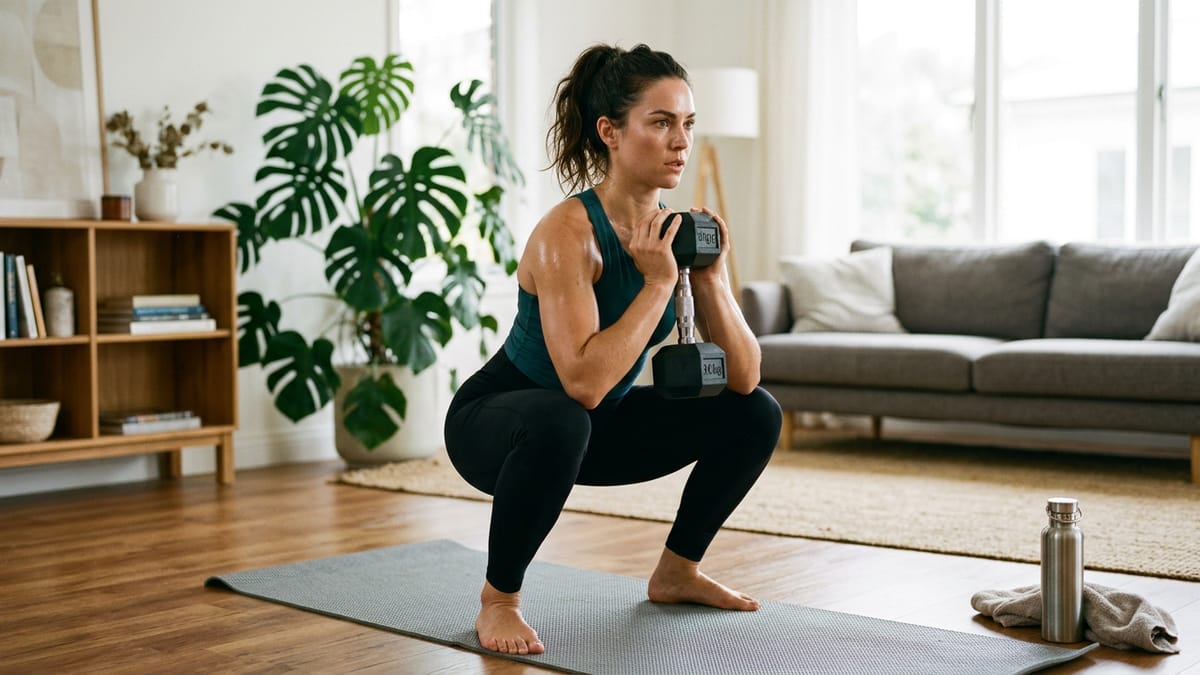
- Minute 4: Dumbbell Goblet Squats. Hold one dumbbell vertically against your chest. Sink deep into the squat, keeping your elbows inside your knees.
- Minute 5: Dumbbell Romanian Deadlifts (RDLs). Hold a dumbbell in each hand. Hinge at the hips with a slight bend in your knees, lowering the weights until you feel a deep stretch in your hamstrings.
Core (1 Minute):
- Minute 6: Weighted Russian Twists. Sit on the floor, lean back slightly, and rotate a single dumbbell from hip to hip.
Block 2: Upper Body Focus
Cardio (3 Minutes):
- Perform 3 straight minutes on a Rowing Machine or Stationary Bike. Keep a steady, challenging pace that you can maintain for the full duration.
Strength (2 Minutes):
- Minute 4: Dumbbell Floor Presses. Lie on your back with your knees bent. Press the dumbbells over your chest, lowering them until your triceps touch the floor.
- Minute 5: Dumbbell Bent-Over Rows. Hinge forward at a 45-degree angle. Pull the dumbbells toward your hips, squeezing your shoulder blades together.
Core (1 Minute):
- Minute 6: Dumbbell Plank Pull-Throughs. Start in a high plank with a dumbbell sitting outside your left hand. Reach under your body with your right hand, grab the dumbbell, and pull it to the right side. Alternate sides.
Pacing Strategies for 6-Minute Blocks
The most common mistake when trying the 3-2-1 workout method is starting the cardio segment too aggressively. Three minutes is an endurance event, not a sprint. Aim for an effort level of about 7 out of 10 during the cardio phase. You should be breathing hard enough that holding a conversation is difficult, but not so hard that you have to stop and rest.
During the strength phase, shift your mindset from speed to control. Do not rush your repetitions. Moving weights or your body slowly creates more time under tension, which is the primary driver of strength adaptation. If you finish your reps too quickly, you defeat the purpose of the two-minute interval.
For the core minute, focus entirely on your breathing. Core exercises require immense stability. Inhale deeply through your nose and exhale forcefully through your mouth during the hardest part of the movement. This will help bring your heart rate down slightly before the next block begins.
Safety and Scaling Guidelines
Always start your session with a five-minute dynamic warm-up to prepare your joints and muscles for the work ahead. Arm circles, leg swings, and light jogging are excellent choices.
If you are a beginner, you can scale the 3-2-1 method by adding structured rest within the blocks. For example, work for 40 seconds and rest for 20 seconds during every minute of the routine. This ensures you can maintain proper form as fatigue sets in. As always, listen to your body and check with a doctor before beginning any new exercise program, especially if you have pre-existing medical conditions or are recovering from an injury.
Frequently asked questions
How many times a week should I do the 3-2-1 workout?
Aim for 2 to 3 times a week, allowing for rest days or lighter recovery sessions in between to let your muscles recover.
Can I change the order of the 3-2-1 workout method?
Yes, but the traditional cardio-first approach helps elevate your heart rate quickly. Finishing with core work allows you to push hard without compromising your heavy lifting form.
Do I need equipment to perform the 3-2-1 method?
Not necessarily. You can easily build a highly effective 3-2-1 routine using only bodyweight movements, though dumbbells or kettlebells can add valuable resistance for the strength phase.
Use this timer
Start the 60s station / 20s move timer — 60s work / 20s rest × 10 rounds. It runs in your browser with sound cues, and there is nothing to install.