How to Train for Functional Fitness Races at Home
By Simple HIIT Timer Team · November 1, 2026
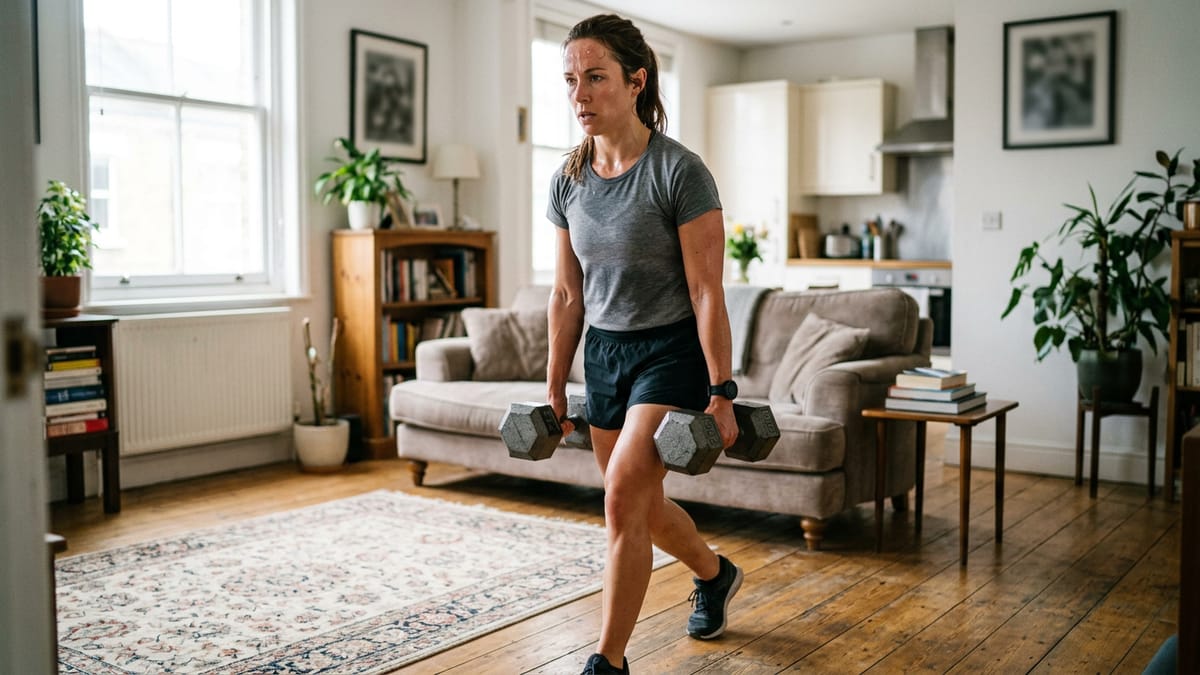
Hybrid fitness racing has completely changed the way everyday athletes train. By bridging the gap between endurance running and functional strength training, these events demand a unique combination of cardiovascular capacity and muscular stamina. You are no longer just a runner or just a lifter; you have to be a true hybrid athlete. But what if you want to prepare for one of these grueling fitness races without paying for an expensive specialized gym membership? You can recreate the physiological demands of a functional fitness race right in your living room or garage using a few pieces of basic equipment and a structured time-based protocol.
The Demands of Hybrid Fitness Racing
Traditional races ask you to pace your heart rate over a set distance. Functional fitness races introduce a massive disruptor: heavy resistance stations. Your heart rate spikes during a cardiovascular effort, and then you immediately transition to a heavy sled push, a farmer's carry, or high-repetition wall balls. This forces your body to clear lactic acid while under mechanical tension, which is exactly why this training style feels so uniquely challenging.
Because you might not have a fifty-yard indoor turf track or a heavy sled at home, distance-based training becomes impractical. Instead, you can simulate these demands using time domains. By matching the average time it takes to complete a racing station, you can train your energy systems to endure the exact same physiological stress. This is where an interval protocol becomes your most valuable training tool.
Orthopedic Considerations: Protecting Your Joints
While functional fitness is incredible for building overall work capacity, it is also highly demanding on your joints. The combination of high-impact cardio, heavy lifting, and accumulated fatigue can challenge your orthopedic health if you are not careful. Form always dictates function, and safety must come first when designing an at-home routine.
To protect your knees, hips, and shoulders, focus on the quality of your movement rather than just the speed. When fatigue sets in during the later rounds of a circuit, your biomechanics naturally want to break down. Your knees might cave inward during a squat, or your lower back might round during a carry. Combat this by scaling the movement or the weight before you compromise your posture. Additionally, ensure you are training on a forgiving surface, wearing supportive footwear, and incorporating adequate mobility work into your rest days to keep your connective tissues resilient.
Fueling the Hybrid Athlete: Nutrition Basics
You cannot separate high-intensity functional training from your nutritional strategy. Because this style of training breaks down muscle tissue while simultaneously draining your glycogen stores, your recovery nutrition needs to be dialed in. Recent discussions in sports nutrition emphasize that supplements and micronutrients work best when paired with consistent exercise.
Protein is the building block for muscle repair, and you should aim to consume a high-quality protein source within an hour of finishing your workout. However, joint and bone health require more than just macronutrients. Calcium and Vitamin D are absolutely crucial for athletes engaged in high-impact or heavy resistance training. Mechanical loading strengthens your bones, but only if the raw materials are available in your bloodstream. Ensure your diet includes leafy greens, dairy, or fortified alternatives, and consider checking your Vitamin D levels if you train indoors all winter.
The At-Home Functional Fitness Circuit
This workout uses a time domain designed to mimic the grueling stations of a fitness race. You will perform two minutes of continuous work, followed by one minute of rest to transition to the next movement. The long working intervals force you to pace yourself, while the strict one-minute rest teaches your heart rate to recover quickly.
To run this workout seamlessly, open the crossfit timer. This will automatically set up the two-minute work and one-minute rest intervals for you. Perform all five stations below in order. That equals one round. Aim for three to four total rounds, which will take roughly forty-five to sixty minutes.
Station 1: The Cardio Simulator (High Knees or Jump Rope)
In a live race, you would be running a kilometer between each functional station. At home, you need a high-cadence movement to spike your heart rate. Two minutes of continuous high knees or jumping rope will flood your legs with fatigue and tax your aerobic system.
If you are doing high knees, pump your arms aggressively and land softly on the balls of your feet. If you are jumping rope, focus on a relaxed shoulder position and a steady rhythm. Do not go at a full sprint in the first thirty seconds; find a pace you can sustain for the entire two-minute block.
Station 2: The Sled Push Alternative (Dumbbell Front Squats)
The sled push is notorious for burning out the quadriceps. To mimic this time under tension, grab a pair of moderate-weight dumbbells and hold them at your shoulders in a front rack position. Perform slow, controlled front squats for the entire two minutes.
Keep your chest tall and your elbows pointed forward. The weight of the dumbbells will pull you forward, forcing your core to work overtime—just like a sled push. If you need to rest, pause at the top of the movement with your legs locked out, take two deep breaths, and begin squatting again.
Station 3: The Wall Ball Alternative (Dumbbell Thrusters)
Wall balls require explosive power from the hips translating into an upper-body push. The dumbbell thruster is the perfect at-home equivalent. Hold a pair of light dumbbells at your shoulders. Perform a full squat, and as you stand up aggressively, use the momentum from your hips to press the dumbbells overhead.
This is a full-body movement that will heavily tax your cardiovascular system. The key to surviving two minutes of thrusters is breathing. Inhale as you lower into the squat, and exhale forcefully as you press the weights overhead. Break the two minutes into manageable sets, such as five reps at a time, taking short pauses in the standing position.
Station 4: The Heavy Carry (Farmer's Carry)
Grip strength and postural endurance are the hallmarks of a successful hybrid athlete. Grab the heaviest pair of dumbbells or kettlebells you can safely handle. Stand tall, pull your shoulder blades back and down, and engage your core. Walk slowly and deliberately around your workout space.
If your space is limited, you can perform a marching farmer's carry in place. The goal is to keep the heavy weights off the floor for the entire two-minute interval. If your grip starts to fail, safely set the weights down, shake your hands out for five seconds, and pick them right back up. Do not let your shoulders round forward as you get tired.
Station 5: The Burpee Broad Jump
Most fitness races feature a burpee broad jump station to test explosive power under extreme fatigue. To perform this, drop down into a standard burpee, ensuring your chest touches the floor. As you hop your feet back to your hands, load your hips and perform a two-foot broad jump forward. Land softly with bent knees, turn around, and repeat the movement.
Because you are already four stations deep, your legs will feel like lead. Focus on the mechanics of the broad jump. A soft, controlled landing is vital for protecting your knees and ankles. If the broad jump is too high-impact, scale the movement to a standard burpee with a small vertical hop at the top.
How to Progress Your Training
The beauty of time-based intervals is that progression is built directly into the format. During your first attempt at this workout, you might spend large portions of the two-minute work intervals resting or shaking out your muscles. Your goal for the next session is not necessarily to lift heavier weights, but to increase your active work time within those two minutes.
Once you can move continuously through all five stations for three rounds with minimal mid-interval resting, you can increase the difficulty. You can add a fourth round, use heavier dumbbells for the squats and carries, or increase the pace of your cardio simulator. Always prioritize perfect technique over adding weight. Functional fitness racing is a test of longevity and endurance, and building a strong, resilient body should always be your ultimate goal.
Frequently asked questions
Can you train for a fitness race without a gym?
Yes, you can simulate the demands of functional fitness racing at home. By combining bodyweight cardio bursts with heavy dumbbell movements using time-based intervals, you can replicate the exact physiological stress of a live event.
How long should functional fitness workouts last?
A typical functional circuit designed for race preparation lasts between forty-five and sixty minutes. The focus is on sustained effort, pacing, and heart rate management rather than pure maximal strength.
Is functional fitness training safe for your joints?
When done with proper form and appropriate scaling, functional training builds joint resilience. Listen to your body, warm up thoroughly, and prioritize technique over speed or weight to protect your orthopedic health.
Use this timer
Start the Intervals: 2 min on / 1 min off timer — 120s work / 60s rest × 5 rounds. It runs in your browser with sound cues, and there is nothing to install.