How to Build a Joint-Friendly Functional Fitness Circuit
By Simple HIIT Timer Team · November 1, 2026
Functional fitness events are more popular than ever. Every weekend, thousands of athletes pack into indoor arenas to push sleds, carry sandbags, and test their cardiovascular limits. But there is a catch: high-volume, competitive fitness can be exceptionally demanding on your joints. The repetitive impact of running on hard floors, combined with heavy barbell lifts under fatigue, often leaves knees, lower backs, and shoulders feeling battered.
If you want the incredible cardiovascular and strength benefits of functional training without the wear and tear of heavy running or high-impact jumping, you need to adjust your approach. By swapping out high-impact movements for joint-friendly alternatives and using a crossfit timer to regulate your work-to-rest ratios, you can build elite work capacity while protecting your body for the long haul.
Why Functional Fitness Demands a Joint-Friendly Approach
Traditional functional fitness routines often blend gymnastics, Olympic weightlifting, and monostructural cardio (like running or jumping rope). While these modalities are highly effective for building athleticism, they introduce a significant amount of impact force.
When you run, your joints absorb forces equivalent to several times your body weight with every stride. When you perform high-repetition barbell snatches or box jumps while exhausted, your form can break down, placing disproportionate stress on your connective tissues rather than your muscles. Over time, this repetitive stress can lead to nagging injuries, inflammation, and extended time away from the gym.
Low-impact functional training removes the abrupt deceleration and shock from your workout. Instead of jumping, you step. Instead of running, you row or pedal. Instead of dynamic Olympic lifts, you perform controlled hinge and squat movements. You still challenge your heart, lungs, and muscles, but you remove the friction that causes joint pain.
The Benefits of Time-Based Circuit Training
One of the best ways to train for functional fitness without overloading your joints is to step away from rep-based races and use time-based intervals. When you are racing to finish 50 reps of an exercise as fast as possible, you are more likely to sacrifice form for speed. When you work for a set amount of time, the pressure to rush disappears.
Using a crossfit timer allows you to focus purely on the quality of your movement. If you have two minutes to work, you can pace yourself, focus on muscle engagement, and maintain perfect posture. This time-under-tension approach is fantastic for building muscular endurance and cardiovascular stamina without joint compromise.
Workout 1: The 15-Minute "No-Pound" Interval Circuit
This circuit is designed to mimic the demands of a functional fitness race, targeting your push, pull, hinge, squat, and carry mechanics. We will use a work-to-rest ratio of two minutes of work followed by one minute of rest. This gives you enough time to accumulate serious volume while providing adequate recovery to keep your form strict.
| Station | Movement | Duration | Focus |
|---|---|---|---|
| 1 | Rowing Machine or SkiErg | 2 minutes | Cardio & Pull |
| 2 | Heavy Farmer's Carry | 2 minutes | Core & Grip |
| 3 | Kettlebell Goblet Squats | 2 minutes | Lower Body Push |
| 4 | Dumbbell Floor Press | 2 minutes | Upper Body Push |
| 5 | Kettlebell Deadlift | 2 minutes | Lower Body Hinge |
Set your timer for 5 rounds of 2 minutes on, 1 minute off. You will complete one full rotation of these five stations, which takes exactly 15 minutes. If you are highly conditioned, you can rest for three minutes after the first rotation and complete a second full block.
Station Breakdown and Form Tips
1. Rowing Machine or SkiErg: These machines provide full-body cardiovascular engagement with zero impact. On the rower, focus on a powerful leg drive rather than yanking with your arms. Keep your stroke rate moderate (around 24-26 strokes per minute) and focus on powerful, deliberate pulls.
2. Heavy Farmer's Carry: Grab a pair of heavy dumbbells or kettlebells. Stand tall, pull your shoulder blades down and back, and brace your core. Walk slowly and deliberately. If you run out of space, turn around slowly. This builds incredible core stability and grip strength without compressing your spine dynamically.
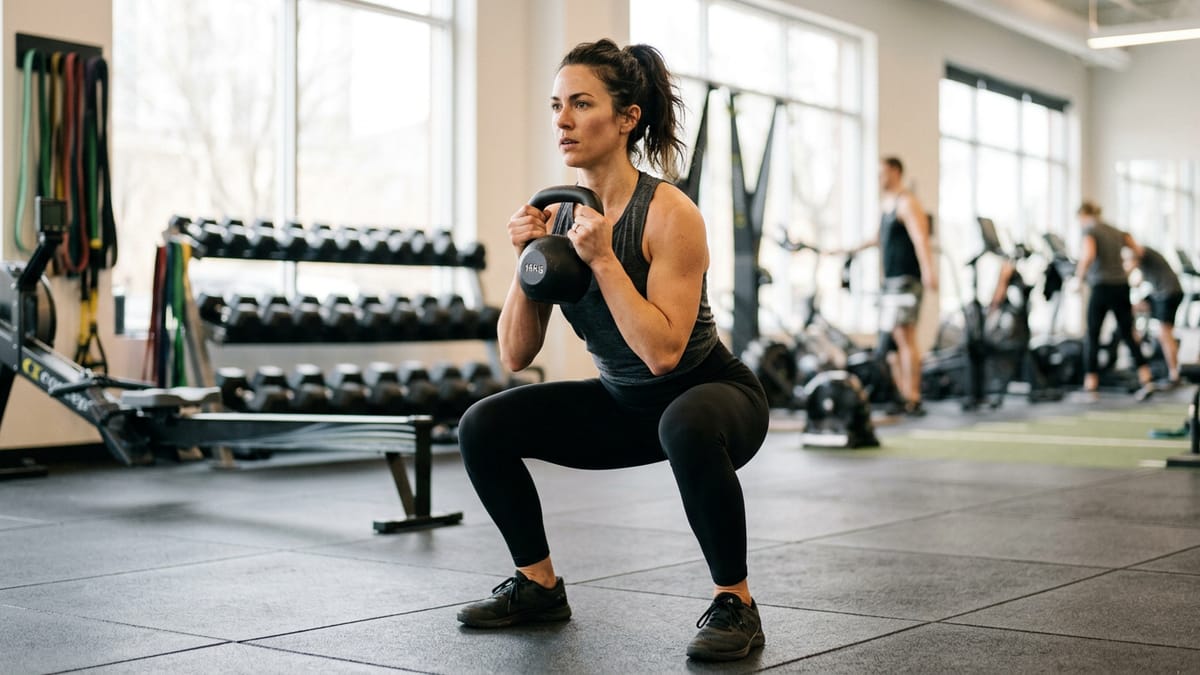
3. Kettlebell Goblet Squats: Hold a kettlebell at chest height. Keep your elbows tucked in and squat down, pushing your knees outward. Only go as deep as your mobility allows without your lower back rounding. The front-loaded weight forces your core to work overtime and keeps your torso upright, which is generally much friendlier on the lower back than heavy barbell back squats.
4. Dumbbell Floor Press: The floor press is a fantastic, shoulder-friendly alternative to the bench press or high-volume push-ups. Lie on your back with your knees bent and feet flat on the floor. Press the dumbbells up until your arms are straight, then lower them until your triceps gently touch the floor. The floor restricts your range of motion, preventing your shoulders from dipping into a vulnerable extended position.
5. Kettlebell Deadlift: Place a heavy kettlebell between your feet. Hinge at your hips, keeping your back flat and your shins relatively vertical. Grab the handle, brace your core, and stand up by driving your hips forward. This trains the posterior chain (glutes and hamstrings) without the complexity or joint stress of barbell cleans or snatches.
Workout 2: The 12-Minute Low-Impact AMRAP
If you are short on time and want a slightly higher intensity, an AMRAP (As Many Rounds As Possible) is a staple of functional fitness. We can easily adapt this format to be joint-friendly. Load up a crossfit timer set to a 12-minute countdown.
Move through the following exercises at a steady, unbroken pace. The goal is not to sprint the first round and burn out, but to find a sustainable rhythm that you can maintain for the entire 12 minutes.
- 10 Dumbbell Renegade Rows: Start in a plank position holding onto two hex dumbbells. Perform a row with your right arm, then your left arm. This equals two reps. Keep your hips as still as possible to protect your lower back and engage your obliques.
- 15 Glute Bridges: Lie on your back with your knees bent. Drive through your heels and squeeze your glutes to lift your hips toward the ceiling. Lower slowly. This provides a massive stimulus to the glutes with zero spinal loading.
- 20 Alternating Reverse Lunges: Step backward into a lunge, gently tapping your back knee to the floor (or stopping just short of the floor). Reverse lunges are significantly easier on the patellar tendon than forward lunges or jumping lunges.
Because these movements are entirely low-impact, your joints will feel fresh, but your muscles and cardiovascular system will be pushed to their limits by minute eight.
Scaling, Warm-Ups, and Safety
Just because a workout is low-impact does not mean you can skip the warm-up. Joint lubrication requires movement. Spend at least five to ten minutes before your circuit performing mobility work. Great warm-up movements include cat-cow stretches, bird-dogs, bodyweight squats, and arm circles. Raising your core temperature ensures your muscles are pliable and ready to support your joints.
If you are a beginner, scale the weights down. Functional fitness is about moving well first and moving heavy second. A 10-pound kettlebell moved with perfect form will yield better long-term results than a 50-pound kettlebell hoisted with a rounded back.
As always, listen to your body. If any movement causes sharp pain—even in a joint-friendly routine—stop immediately. Low-impact training is about sustainability. Always consult with a healthcare professional before starting a new exercise regimen, particularly if you have pre-existing joint conditions, injuries, or are pregnant.
By prioritizing time-based intervals, removing heavy impacts, and focusing on strict movement quality, you can enjoy all the benefits of the functional fitness craze. Your heart will get stronger, your muscles will grow, and your joints will thank you for years to come.
Frequently asked questions
Can I build muscle with low-impact functional fitness?
Yes, low-impact does not mean low-effort. By using challenging weights for exercises like farmer's carries and deadlifts, you create enough mechanical tension to stimulate muscle growth while protecting your joints.
How often should I do a functional fitness circuit?
For most people, two to three functional circuits per week is plenty. Alternate these sessions with dedicated strength training, steady-state cardio, or active recovery days to prevent overtraining.
What is the best timer setting for functional intervals?
A common approach is working for two minutes and resting for one minute, which builds aerobic capacity and muscular endurance. You can easily track this using a CrossFit timer set to standard interval presets.
Use this timer
Start the Intervals: 2 min on / 1 min off timer — 120s work / 60s rest × 5 rounds. It runs in your browser with sound cues, and there is nothing to install.