The 5-Minute Stair Interval Workout for Better Cardio
By Simple HIIT Timer Team · October 27, 2026
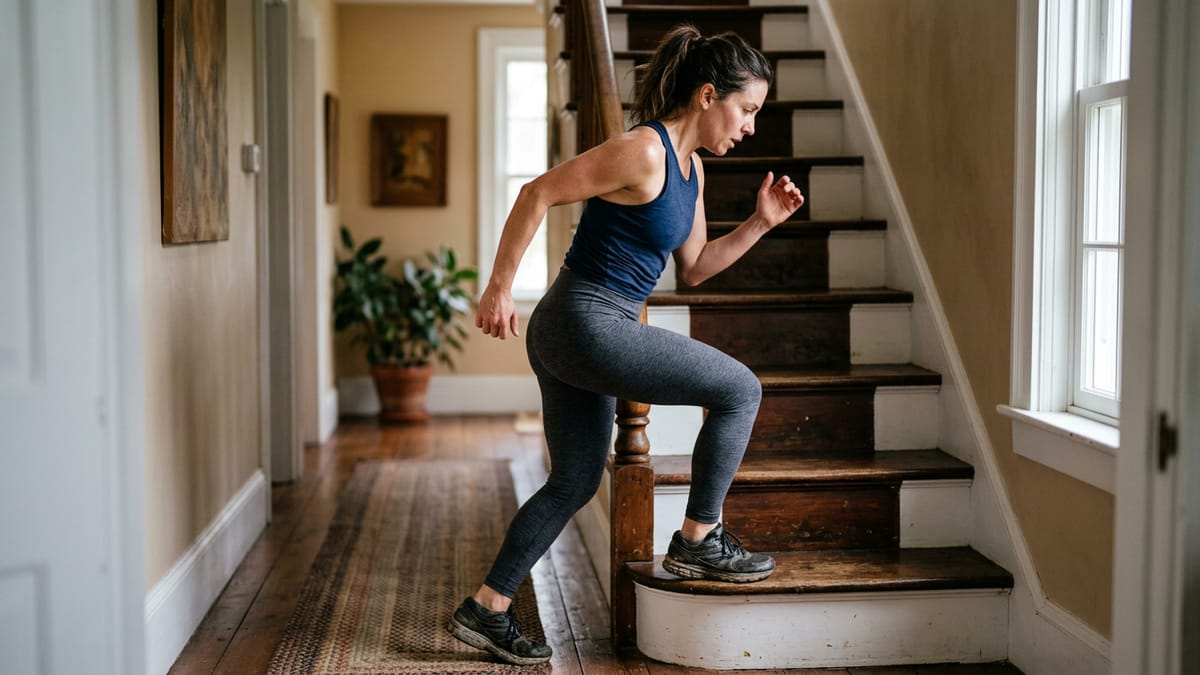
Finding time to train is one of the most common hurdles in any fitness journey. If you are balancing work, family, and personal responsibilities, carving out a full hour for the gym can feel impossible. However, recent trends in fitness emphasize the power of the "exercise snack"—a brief, highly focused burst of activity designed to elevate your heart rate and challenge your muscles in a fraction of the time.
One of the most potent and accessible forms of this quick-burst training is the stair interval workout. You do not need a stadium bleacher, an expensive stair-climbing machine, or even a full flight of stairs to get a great workout. In fact, you can perform a highly effective routine using nothing more than the bottom step of your home staircase or a sturdy plyometric box. By moving your body weight vertically against gravity, you demand significant effort from your cardiovascular system and the large muscle groups of your lower body.
The Science Behind the 5-Minute Workout
It might sound too good to be true, but short, intense workouts carry legitimate benefits. Research on interval training suggests that brief, intense bursts of activity can significantly improve cardiovascular markers and increase your VO2 max (how efficiently your body uses oxygen) when performed consistently.
A stair interval workout combines the cardiovascular spike of sprinting with the resistance element of a lunge or squat. Every time you step up, you are pushing your entire body weight upward. Doing this rapidly in an interval format forces your heart and lungs to work overtime, while simultaneously building muscular endurance in your legs.
Muscles Targeted During Stair Intervals
- Quadriceps: The front of your thighs do the heavy lifting as you extend your knee to step up.
- Glutes: Your gluteus maximus is the primary driver for hip extension, firing forcefully as you push your body to the top of the step.
- Calves: Your calves stabilize your ankle and provide a final push off the ground.
- Core: To maintain an upright posture while moving rapidly, your abdominal and lower back muscles must stay engaged.
Before You Step Up: Safety and Setup
Because this routine relies on speed and rapid changes of direction, safety is your top priority. Always check with a doctor before starting a new exercise regimen, especially if you have existing knee, ankle, or cardiovascular conditions. If you experience sharp pain or dizziness at any point, stop immediately.
Choosing the Right Step
For this routine, you only need one single step. The bottom step of a standard staircase is perfect because it is anchored and secure. If you do not have a staircase, you can use a sturdy, low plyometric box or an aerobic step bench. Ensure the surface is dry, stable, and will not slide on the floor when you apply lateral force.
Proper Footwear
Do not perform rapid step-ups in socks, slippers, or bare feet unless you are highly experienced with barefoot training on a textured surface. Wear supportive athletic shoes with good grip to prevent slipping and to absorb the slight impact of stepping back down.
The 5-Minute Stair Interval Workout Plan
This routine uses a Tabata-style framework. You will start with exactly one minute of warming up, followed immediately by four minutes of high-intensity intervals. For the intervals, you will work as hard as you can for 20 seconds, then rest for 10 seconds. You will repeat this cycle 8 times.
To keep yourself on track without having to stare at a clock, load up the Tabata Timer using the Classic Tabata (4 min) preset. Set it nearby where you can hear the audio cues.
Minute 1: The Active Warm-Up
Do not skip this step. Going from a resting state to maximum effort can strain cold muscles. Spend the first 60 seconds preparing your body for the work ahead.
- 0:00 - 0:30: Perform slow, deliberate step-ups. Step up with your right foot, bring your left foot up, step down with your right foot, then step down with your left foot. Keep the pace conversational.
- 0:30 - 0:50: Switch your lead leg. Step up with your left foot first. Increase your pace slightly.
- 0:50 - 1:00: Stand on the floor and perform light, alternating high knees to loosen your hips and elevate your heart rate just before the timer begins.
Minutes 2 to 5: The Tabata Intervals
Start your interval timer. For the next four minutes, you will alternate between maximum-effort step-ups and complete rest.
| Round | Work Phase (20 Seconds) | Rest Phase (10 Seconds) |
|---|---|---|
| 1 | Rapid alternating step-ups | Stand still, breathe deeply |
| 2 | Rapid alternating step-ups | Stand still, breathe deeply |
| 3 | Rapid alternating step-ups | Stand still, breathe deeply |
| 4 | Rapid alternating step-ups | Stand still, breathe deeply |
| 5 | Rapid alternating step-ups | Stand still, breathe deeply |
| 6 | Rapid alternating step-ups | Stand still, breathe deeply |
| 7 | Rapid alternating step-ups | Stand still, breathe deeply |
| 8 | Rapid alternating step-ups | Stand still, breathe deeply |
How to perform the rapid alternating step-up: Plant your right foot entirely on the step. Drive through your right heel to lift your body, and lightly tap your left foot on the step. Immediately step back down with your left foot, followed by your right. On the next repetition, lead with your left foot. Move as quickly as you safely can while maintaining perfect form.
Mastering Stair Climbing Form
Even though the goal is speed, poor mechanics will slow you down and increase your risk of injury. Focus on these key technical cues during your work intervals.
Full Foot Contact
When you place your foot on the step, your entire heel must be supported. If your heel is hanging off the edge, you place unnecessary stress on your Achilles tendon and calf, and you lose the power generated by your glutes. Plant your foot firmly and squarely.
Drive Through the Heel
Avoid pushing up entirely from the ball of your foot. While your calf helps, the majority of the power should come from driving your heel down into the step. This activates your glutes and hamstrings, spreading the workload across the largest muscles in your body.
Maintain an Upright Chest
As you get tired, your natural instinct will be to hinge forward at the waist and look down at your feet. While you should glance down to ensure safe foot placement, keep your chest proud and your shoulders back. Hunching over restricts your breathing and limits the amount of oxygen you can take in during these critical 20-second bursts.
Soft Landings
The downward phase of the movement is just as important as the upward phase. Do not slam your feet backward into the floor. Control your descent, landing softly on the ball of your foot before letting your heel touch the ground. This protects your knees and lower back from the shock of impact.
Scaling the Workout for Your Fitness Level
The beauty of a time-based stair interval workout is that it automatically adjusts to your current fitness level. Because you are working for time rather than a set number of repetitions, a beginner and an advanced athlete can do the exact same workout side by side. However, if you want to further customize the intensity, try these modifications.
Beginner Modifications
If the 20-seconds-on, 10-seconds-off pace feels too frantic, or if you are still building your balance and coordination, you can adjust the intervals to give yourself more recovery time.
Instead of the Tabata protocol, use the Exercise Timer with the Beginner (30s / 30s) preset. This gives you 30 seconds to perform your step-ups at a moderate, steady pace, followed by a full 30 seconds of rest. You will complete 8 rounds, making the total workout 8 minutes long instead of 5, but the equal work-to-rest ratio will keep your heart rate manageable. Additionally, feel free to lightly hold onto a wall or handrail for balance as you step.
Advanced Challenges
If you have been doing high-intensity interval training for a while and want to make the 5-minute stair interval workout even more demanding, try incorporating these variations into your 20-second work windows:
- Weighted Step-Ups: Hold a light pair of dumbbells at your sides or a single kettlebell in a goblet position at your chest. The added resistance will force your legs to work significantly harder.
- Plyometric Step-Ups: Instead of stepping up one foot at a time, place one foot on the step and explosively jump upward, switching your feet in mid-air so you land with the opposite foot on the step. This requires excellent coordination and joint stability.
- Skip-a-Step: If your staircase is safe and you have the mobility, step up to the second step instead of the first. This deeper range of motion mimics a deep lunge, providing a massive challenge to your glutes and quadriceps. Because the movement takes longer, focus on power rather than pure speed.
How to Program Stair Intervals Into Your Week
Because this workout is incredibly brief, it is easy to weave into your existing schedule. Here are a few ways to utilize the 5-minute stair interval workout:
The Morning Wake-Up: Perform this routine right after you wake up (after drinking a glass of water). It will spike your core temperature, increase blood flow, and release endorphins, acting as a natural substitute for your morning coffee.
The WFH Break: If you work from home and spend hours sitting at a desk, your hip flexors tighten and your glutes become inactive. Taking five minutes in the middle of your workday to perform this routine will break up the sedentary time and improve your focus for the afternoon.
The Strength Finisher: If you already lift weights but struggle to find the motivation for long cardio sessions, use this routine at the very end of your upper body or core training days. It serves as a fantastic metabolic finisher to burn out your legs and empty your remaining energy reserves.
Aim to complete this 5-minute routine three to four times a week. Keep track of how many step-ups you can manage within a single 20-second interval. As your cardiovascular fitness and leg strength improve, you will find yourself moving faster, recovering quicker, and stepping higher.
Frequently asked questions
Can I get a good workout in just 5 minutes?
Yes. By using high-intensity interval training (HIIT), a 5-minute routine elevates your heart rate rapidly, offering significant cardiovascular benefits and muscular endurance improvements when done consistently.
Do I need a full staircase for this workout?
No. You only need the bottom step of a staircase or a sturdy plyometric box to perform rapid alternating step-ups for the entire routine.
How many times a week should I do a stair interval workout?
For best results, incorporate this 5-minute routine 3 to 4 times a week. It serves well as a standalone exercise snack or a quick finisher to your regular strength training.
Use this timer
Start the Classic Tabata (4 min) timer — 20s work / 10s rest × 8 rounds. It runs in your browser with sound cues, and there is nothing to install.