The 20-Minute Easy Bodyweight Fitness Routine for Beginners
By Simple HIIT Timer Team · November 4, 2026
Finding a starting point for a healthier lifestyle often feels overwhelming, especially when you are bombarded with complicated programs and expensive equipment requirements. The good news is that you do not need a fully stocked gym to build a solid foundation of strength, improve your cardiovascular health, and increase your mobility. An easy bodyweight fitness routine is the most efficient way to teach your muscles how to move properly while conditioning your heart and lungs.
By relying entirely on your own body weight, you eliminate the barrier of travel time to a gym and the cost of gear. When combined with a simple interval timer, a basic bodyweight circuit becomes a highly effective, scalable workout that takes the guesswork out of your training. This guide breaks down exactly how to structure and execute a beginner-friendly routine that fits seamlessly into your daily life.
Why Choose a Bodyweight Routine?
Bodyweight training relies on gravity and your own mass to provide resistance. For beginners, this approach offers several distinct advantages over jumping straight into heavy weightlifting or high-impact cardio.
First, it builds relative strength—your ability to control your body through space. Mastering fundamental movement patterns like squatting, pushing, pulling, and hinging without external loads significantly lowers your risk of injury. It allows your tendons, ligaments, and joints to adapt to physical stress at a safe, manageable pace.
Second, bodyweight exercises are endlessly modifiable. If a standard push-up is too difficult, you can elevate your hands on a wall or a sturdy chair. If a movement feels too easy, you can slow down the tempo to increase the time your muscles spend under tension. This adaptability ensures that an easy bodyweight fitness routine can grow with you as your fitness level improves.
The Power of Time-Based Training
Many traditional workout plans focus on hitting a specific number of repetitions, such as three sets of ten reps. While effective, counting reps can be discouraging for beginners who might struggle to hit the target number. This is where time-based interval training shines.
Instead of aiming for a rep count, you work for a set amount of time and then rest for a set amount of time. If you use an exercise timer, you only need to focus on moving with good form until the buzzer sounds. On days when you feel energetic, you might complete 12 squats in your work window. On days when you feel sluggish, you might only complete eight. Both are perfect because you are working at your own capacity for the allotted time.
For this beginner routine, we will use a 30-seconds-on, 30-seconds-off structure. This provides ample time to perform the exercises without rushing, followed by an equal amount of rest to catch your breath and prepare for the next movement.
The Essential Dynamic Warm-Up
Never skip your warm-up. Preparing your body for movement increases blood flow to your muscles, lubricates your joints, and mentally prepares you for the work ahead. Spend five minutes performing these gentle movements before starting your timer:
- Arm Circles: Stand tall and extend your arms to the sides. Make 10 small forward circles, gradually increasing the size. Repeat in the reverse direction.
- Torso Twists: Plant your feet shoulder-width apart. Gently twist your upper body from left to right, letting your arms swing naturally. Do this for 30 seconds.
- Leg Swings: Hold onto a wall or chair for balance. Swing your right leg forward and backward 10 times, keeping your core engaged. Switch legs.
- High Steps: March in place for one minute, bringing your knees up toward your waist while pumping your arms.
The 8-Move Easy Bodyweight Fitness Routine
This routine consists of eight fundamental exercises designed to target your entire body. Set your timer for 30 seconds of work and 30 seconds of rest for 8 rounds. Completing one full circuit takes exactly 8 minutes. Beginners should aim for two total circuits with a one-minute rest in between, bringing the total workout time to under 20 minutes.
| Station | Exercise | Target Area | Work / Rest |
|---|---|---|---|
| 1 | Bodyweight Squats | Legs and Glutes | 30s / 30s |
| 2 | Wall or Incline Push-Ups | Chest, Shoulders, Triceps | 30s / 30s |
| 3 | Reverse Lunges | Legs and Balance | 30s / 30s |
| 4 | Glute Bridges | Posterior Chain | 30s / 30s |
| 5 | Plank Hold | Core | 30s / 30s |
| 6 | Bird-Dog | Core and Back | 30s / 30s |
| 7 | Marching in Place | Cardio | 30s / 30s |
| 8 | Step Jacks | Cardio and Shoulders | 30s / 30s |
1. Bodyweight Squats
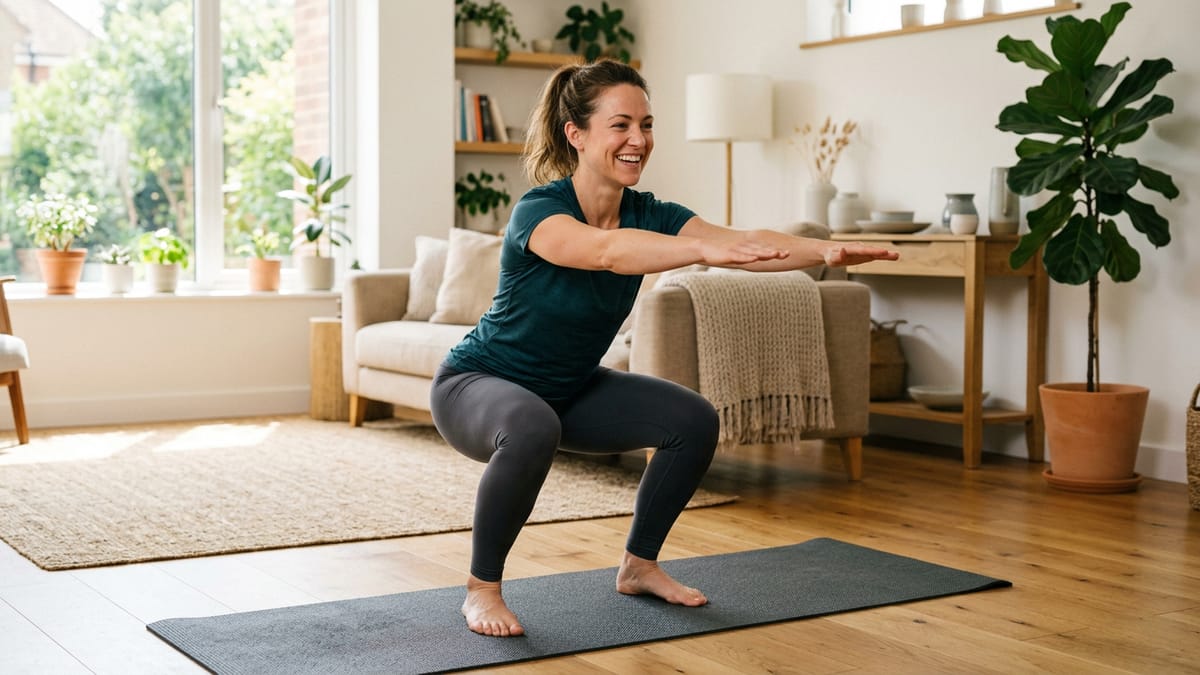
Stand with your feet slightly wider than shoulder-width apart, toes pointed slightly outward. Keep your chest up and your core braced. Push your hips back and bend your knees as if you are sitting in a chair. Lower yourself until your thighs are parallel to the floor, or as low as comfortable. Drive through your entire foot to return to the standing position. If you struggle with balance, perform these by sitting down onto a sturdy chair and standing right back up.
2. Wall or Incline Push-Ups
Standard push-ups on the floor can be too demanding for a beginner. Instead, place your hands slightly wider than shoulder-width apart on a sturdy wall, countertop, or the back of a heavy sofa. Step your feet back so your body forms a straight line from your head to your heels. Lower your chest toward the surface by bending your elbows, keeping your core tight. Push back to the starting position. The higher the surface, the easier the movement will be.
3. Reverse Lunges
Stand tall with your feet together. Step your right foot backward, dropping your right knee straight down toward the floor until both knees are bent at approximately a 90-degree angle. Keep your front shin relatively vertical and your chest upright. Push off your back foot to return to the starting position, and then alternate to the left leg. If you feel unsteady, hold onto a wall or chair with one hand.
4. Glute Bridges
Lie flat on your back on a comfortable mat or rug. Bend your knees and place your feet flat on the floor, hip-width apart, close to your glutes. Rest your arms at your sides. Squeeze your glutes and push through your heels to lift your hips toward the ceiling until your body forms a straight line from your knees to your shoulders. Pause for a second at the top, then slowly lower your hips back down.
5. Plank Hold
Place your forearms on the floor with your elbows directly under your shoulders. Step your feet back and lift your hips so your body forms a straight line. Squeeze your core, glutes, and thighs to maintain the position. Do not let your lower back sag or your hips pike upward into the air. If a full plank is too difficult, perform the exact same movement with your knees resting on the floor.
6. Bird-Dog
Begin on your hands and knees in a tabletop position. Your hands should be under your shoulders and your knees under your hips. Keep your back flat and your neck neutral. Simultaneously reach your right arm forward and kick your left leg straight back. Hold this extended position for one second, focusing on balance and keeping your hips parallel to the floor. Return to the starting position and switch to the left arm and right leg.
7. Marching in Place
This is your first dedicated cardio interval. Stand tall and begin marching in place at a brisk pace. Drive your knees up as high as you comfortably can and pump your arms in opposition to your legs. To increase the intensity, speed up your marching rhythm. Focus on light, controlled steps rather than stomping.
8. Step Jacks
A low-impact alternative to jumping jacks, step jacks keep your heart rate up without jarring your joints. Start with your feet together and your arms at your sides. Step your right foot out to the side while simultaneously sweeping both arms overhead. Step back to the center and bring your arms down. Immediately step your left foot out to the side and sweep your arms overhead again. Continue alternating sides quickly for the full 30 seconds.
How to Progress Your Workouts
Your body will eventually adapt to this easy bodyweight fitness routine. When you find that you are no longer breathing heavily by the end of the 20 minutes, or the movements feel completely effortless, it is time to progress. You do not need to abandon the routine; you simply need to make it more challenging.
Your first option is to adjust your interval timer. Instead of 30 seconds of work and 30 seconds of rest, try moving to a 40-seconds-on, 20-seconds-off format using a circuit timer. This increases your active work time and decreases your recovery window, significantly boosting the cardiovascular demand.
Your second option is to advance the movements themselves. Move your incline push-ups closer to the floor. Transition from step jacks to full jumping jacks. Try holding a pair of water bottles or soup cans while doing your squats and lunges to introduce light resistance.
Safety and Consistency
Before beginning any new exercise program, especially if you have existing medical conditions, injuries, or are pregnant, check with your doctor. Always prioritize proper form over speed. If you feel sharp pain during any movement, stop immediately. Muscle fatigue and a burning sensation are normal; sharp joint pain is not.
Consistency is the ultimate driver of fitness results. You do not need to work out for hours every day to see changes. Committing to this 20-minute easy bodyweight fitness routine three times a week will yield far better results than completing one grueling two-hour workout and then doing nothing for the rest of the month. Load up your timer, clear a small space in your living room, and start moving.
Frequently asked questions
Can I build muscle with just an easy bodyweight fitness routine?
Yes, beginners can definitely build muscle and increase strength using only bodyweight exercises. By consistently challenging your muscles and eventually progressing to harder variations or longer work intervals, you stimulate muscle growth.
How many times a week should I do this bodyweight circuit?
For optimal results, aim to complete this routine 3 to 4 times per week. This provides a good balance of physical stimulus and essential recovery time for your muscles.
What if 30 seconds of work is too difficult for me right now?
If 30 seconds feels like too much, stop and rest whenever you need to within that work window. You can also modify the exercises, such as doing push-ups against a wall or resting your knees on the floor during planks.
Use this timer
Start the Beginner: 30s / 30s timer — 30s work / 30s rest × 8 rounds. It runs in your browser with sound cues, and there is nothing to install.