Pyramid Interval Training: The Ultimate Endurance Workout
By Simple HIIT Timer Team · November 6, 2026
What Is Pyramid Interval Training?
Pyramid interval training is a dynamic workout method that breaks the monotony of standard, fixed-interval routines. Instead of performing the same work and rest periods over and over, a pyramid workout involves systematically increasing and then decreasing the duration of your work intervals. You 'climb' the pyramid with progressively longer efforts, hit a peak, and then 'descend' with shorter efforts.
This structure is a powerful tool for improving both physical and mental stamina. By constantly changing the demand, you challenge different energy systems and keep your mind engaged, pushing you to adapt and grow stronger.
The Benefits of Pyramid Interval Training
Incorporating pyramids into your fitness plan offers several distinct advantages over traditional interval structures.
Mental Engagement
The changing work periods prevent boredom and autopilot. Each interval presents a new challenge, requiring you to stay focused on the task at hand rather than just counting down the rounds. This can make a tough workout feel like it’s passing more quickly.
Progressive Overload Within a Session
A pyramid naturally integrates progressive overload into a single workout. You start with manageable intervals, build to a peak of maximum effort and duration, and then get the psychological boost of the intervals becoming shorter again. This teaches your body to handle sustained effort and recover while still working.
Improved Aerobic and Anaerobic Fitness
The shorter intervals at the beginning and end of the pyramid primarily tax your anaerobic system for quick, powerful bursts. The longer interval at the peak pushes your aerobic system, building cardiovascular endurance. Training both in one session is an efficient way to become a more well-rounded athlete.
Versatility
The pyramid concept is incredibly versatile. You can apply it to nearly any form of exercise, including running, cycling, rowing, swimming, or bodyweight exercises. You can adjust the peak time, the number of steps in the pyramid, and the rest periods to perfectly match your fitness level and goals.
The 22-Minute Bodyweight Pyramid Workout
This routine is designed to be a challenging, full-body workout that you can do anywhere, with no equipment needed. The goal is to complete four pyramid blocks. Each block lasts just under five minutes. You will rest for 75 seconds between each block.
The Pyramid Block (Complete 4 Times)
For each block, you will perform five different exercises, one after the other, following the pyramid interval structure. Rest for 75 seconds after completing the full five-exercise block, then repeat for a total of four rounds.
- High Knees: 30 seconds work, 15 seconds rest
- Bodyweight Squats: 45 seconds work, 15 seconds rest
- Burpees: 60 seconds work, 15 seconds rest
- Push-ups: 45 seconds work, 15 seconds rest
- Mountain Climbers: 30 seconds work
After your final set of Mountain Climbers, take your 75-second rest before starting the next block with High Knees.
Exercise Guide and Modifications
Focus on maintaining good form, especially as you get tired. Quality of movement is always more important than speed.
- High Knees: Stand tall and run in place, driving your knees up toward your chest. Keep your core engaged and land softly on the balls of your feet. For a lower-impact version, perform a high-knee march without the jump.
- Bodyweight Squats: Stand with your feet shoulder-width apart. Push your hips back and bend your knees as if sitting in a chair. Keep your chest up and back straight. Lower until your thighs are parallel to the floor, then drive through your heels to return to standing.
- Burpees: This is the peak of the pyramid. Start standing, drop into a squat, place your hands on the floor, and kick your feet back into a plank position. Perform a push-up, then jump your feet back to your hands, and explode up into a jump. Modification: Skip the push-up and/or the final jump. You can also step your feet back and forward instead of jumping.
- Push-ups: Start in a high plank position with your hands slightly wider than your shoulders. Lower your body until your chest nearly touches the floor, keeping your back flat and core tight. Push back up to the starting position. Modification: Perform push-ups on your knees or against an elevated surface like a bench or wall.
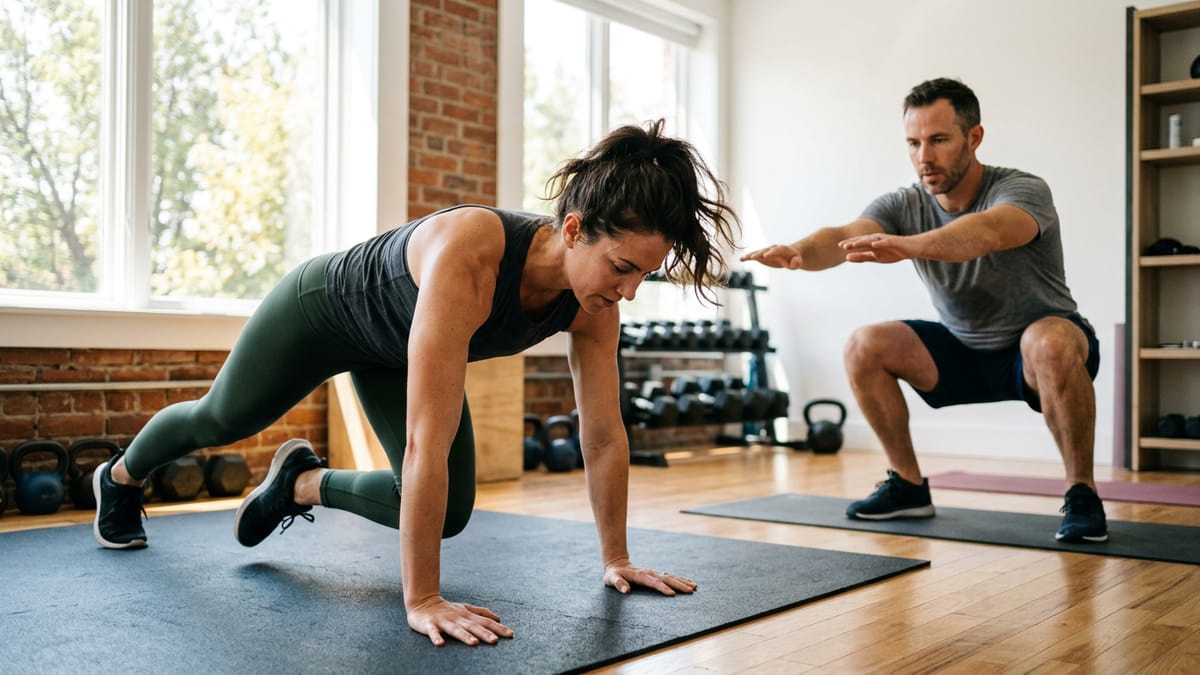
- Mountain Climbers: From a high plank position, drive one knee toward your chest, then quickly switch legs. It should feel like you're running against the floor. Keep your hips low and your back flat.
How to Set Up Your Timer
Because the work intervals change from round to round, you can't use a single preset for this specific workout. The best approach is to use a flexible interval timer and create a custom timer with five different intervals. Alternatively, you can quickly adjust a simple timer before each exercise.
For example, you would set the timer for 30 seconds of work and 15 seconds of rest for your High Knees. For the next round, you'd adjust it to 45 seconds of work. While this requires a moment of adjustment between exercises, it allows you to perfectly execute the pyramid structure and get all the benefits.
Safety and Customization
Always start your workout with a 5-minute warm-up of light cardio and dynamic stretching, and end with a 5-minute cool-down of static stretching.
How to Make it Easier
- Increase Rest: Take 30 seconds of rest between each exercise instead of 15.
- Shorten the Peak: Make the longest interval 45 seconds instead of 60. Your pyramid would be 30-45-30.
- Reduce Rounds: Start with 2 or 3 blocks instead of 4.
- Use Modifications: Consistently use the lower-impact exercise variations described above.
How to Make it Harder
- Decrease Rest: Shorten your rest between blocks to 45 or 60 seconds.
- Add Reps: For exercises like squats and push-ups, try to get more reps in the same amount of time.
- Go Explosive: Change bodyweight squats to squat jumps for an extra challenge.
Listen to your body. High-intensity training is demanding. If you feel pain (not to be confused with muscle fatigue), stop and rest. It’s better to finish a workout healthy than to push through an injury.
Frequently asked questions
What is the point of pyramid interval training?
Pyramid intervals keep your workout engaging by changing the duration of the work periods. This structure challenges both your aerobic and anaerobic systems, helping to improve overall endurance and break through fitness plateaus.
Can I do pyramid training with weights?
Absolutely. You can apply the pyramid interval structure to exercises with dumbbells or kettlebells. Just ensure you choose a weight that allows you to maintain good form throughout the longest work interval.
How often should I do a pyramid HIIT workout?
Like other high-intensity workouts, 2-3 times per week on non-consecutive days is a great target. This allows your body adequate time to recover and adapt, which is crucial for seeing results and preventing injury.
Is pyramid training good for beginners?
Yes, beginners can use pyramid training by choosing simpler exercises, extending the rest periods, or starting with a shorter peak interval. It's a flexible format that can be scaled to any fitness level.
Use this timer
Start the Interval Timer — Work and rest times are ready to edit. It runs in your browser with sound cues, and there is nothing to install.