Battle Ropes Interval Workout: Build Power and Conditioning
By Simple HIIT Timer Team · November 13, 2026
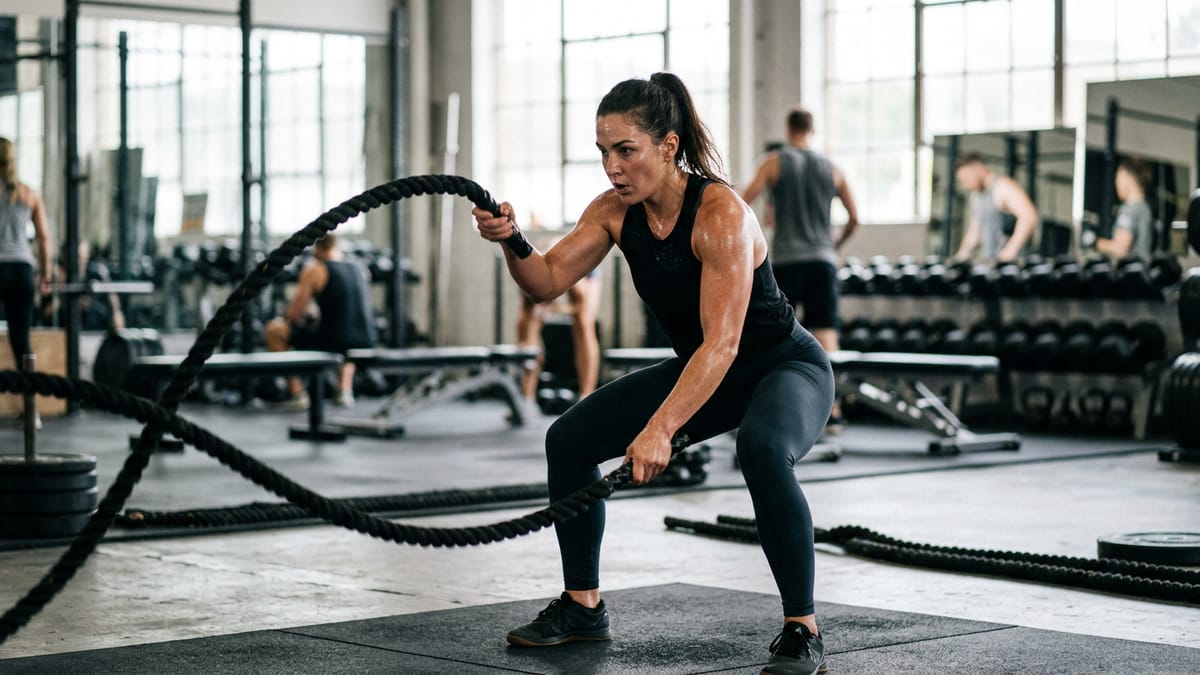
Battle ropes offer one of the most effective ways to build upper-body power and cardiovascular endurance simultaneously. While many conditioning tools like treadmills, bikes, and rowing machines focus heavily on the lower body, battle ropes shift the primary metabolic demand to your arms, shoulders, back, and core. When paired with a structured interval protocol, a battle ropes routine challenges your muscular endurance and drives up your heart rate in a fraction of the time a traditional cardio session would take.
Using thick, heavy ropes requires you to generate force from your legs, stabilize that force through your midsection, and express it through your arms. Because you are constantly fighting the weight and momentum of the ropes, your muscles remain under tension throughout the entire work period. By tracking your work and rest periods with a reliable workout timer, you can ensure you maintain the right intensity to trigger cardiovascular adaptations without burning out entirely in the first three minutes.
The Benefits of Battle Rope Interval Training
Integrating battle ropes into your weekly routine provides several distinct advantages that are difficult to replicate with free weights or standard cardio machines.
Unmatched Upper-Body Conditioning
Traditional cardio heavily relies on your legs. If you are recovering from a lower-body injury, dealing with knee pain, or simply want to rest your legs after a heavy squat day, battle ropes allow you to achieve a maximum-heart-rate stimulus using your upper half. The continuous wave motions demand massive oxygen delivery to your shoulders, lats, and forearms.
Intense Core Stabilization
To move the ropes effectively, your torso must remain entirely stable. Every time you snap the rope up and down or side to side, the recoil attempts to pull your body off balance. Your abdominals, obliques, and lower back muscles must contract isometrically to keep your spine neutral and your hips square. This makes battle ropes an incredibly effective functional core exercise.
Low-Impact Intensity
Despite the high cardiovascular demand, battle ropes are entirely low-impact. Your feet remain planted on the floor, meaning there is no shock traveling up through your ankles, knees, or hips. This makes it an excellent conditioning choice for heavier athletes, older trainees, or anyone looking to protect their joints while still training at a high intensity.
Setting Up: The Athletic Stance
Before starting the clock, you need to establish a strong foundation. Moving the ropes effectively starts from the ground up. If your stance is weak, your arms will fatigue prematurely, and you will not generate enough power to send the waves all the way to the anchor point.
- Foot placement: Stand with your feet shoulder-width apart or slightly wider. Point your toes straight ahead or slightly outward.
- Hip hinge: Push your hips back slightly and bend your knees to drop into a quarter-squat. Keep your chest up and your back flat.
- Grip: Hold the ends of the ropes with a neutral grip, like you are holding a microphone. Squeeze the handles firmly, but avoid a death grip, which will burn out your forearms too quickly.
- Slack: This is the most common setup mistake. If the rope is pulled tight, you cannot make waves. Take one large step toward the anchor point so the rope hangs with some slack on the floor before you begin.
5 Essential Battle Rope Movements
To get the most out of your interval training, utilize a variety of movements to target different muscle groups and movement planes.
1. Alternating Waves
This is the foundational battle rope exercise. In your athletic stance, rapidly pump your arms up and down in an alternating fashion. When your right arm goes up, your left arm goes down. Keep the movement relatively compact—your hands should only travel from about your belly button to your chin. The goal is speed and maintaining continuous, rolling waves all the way to the anchor.
2. Double Waves
Instead of alternating, move both arms up and down simultaneously. This requires more power from your lats and core to stabilize the synchronized recoil. You will naturally generate larger waves, but the pace will be slightly slower than the alternating variation.
3. Power Slams
Power slams shift the focus from speed to raw explosiveness. Rise slightly out of your squat, bringing both arms high above your head. In one fluid, aggressive motion, drop your hips back down and slam the ropes into the floor as hard as you can. Reset quickly and repeat. This movement heavily recruits your lats, core, and glutes.
4. Snakes
Instead of creating vertical waves, snakes require horizontal movement. Lower your hands closer to your waist and whip your arms in and out, crossing them toward each other and then pulling them apart. The ropes should slither across the floor like snakes. This variation places intense tension on your chest, shoulders, and obliques.
5. Outside Circles
Hold the ropes in front of you and draw large outward circles with your hands. Your right hand will draw a clockwise circle while your left hand draws a counter-clockwise circle. This movement heavily engages your rotator cuff, deltoids, and upper back, making it excellent for shoulder health and endurance.
The 15-Minute Battle Ropes Interval Workout
This routine uses a 1:1 work-to-rest ratio, making it ideal for building both aerobic and anaerobic capacity. You will work for 30 seconds, followed by 30 seconds of complete rest. We will cycle through the five essential movements three times for a total of 15 rounds.
Set up your workout timer for 15 rounds of 30 seconds of work and 30 seconds of rest. During the work intervals, push for maximum effort. During the rest, stand up, shake out your arms, and focus on taking deep, controlled breaths to lower your heart rate before the next bell.
| Round | Exercise | Work | Rest |
|---|---|---|---|
| 1 | Alternating Waves | 30 sec | 30 sec |
| 2 | Double Waves | 30 sec | 30 sec |
| 3 | Power Slams | 30 sec | 30 sec |
| 4 | Snakes | 30 sec | 30 sec |
| 5 | Outside Circles | 30 sec | 30 sec |
| 6 | Alternating Waves | 30 sec | 30 sec |
| 7 | Double Waves | 30 sec | 30 sec |
| 8 | Power Slams | 30 sec | 30 sec |
| 9 | Snakes | 30 sec | 30 sec |
| 10 | Outside Circles | 30 sec | 30 sec |
| 11 | Alternating Waves | 30 sec | 30 sec |
| 12 | Double Waves | 30 sec | 30 sec |
| 13 | Power Slams | 30 sec | 30 sec |
| 14 | Snakes | 30 sec | 30 sec |
| 15 | Outside Circles | 30 sec | 30 sec |
Scaling the Workout for Your Fitness Level
Battle ropes are highly adaptable. If the 15-minute routine feels too difficult or too easy, you can adjust the timing intervals or the rope specifications to match your current fitness level.
Modifications for Beginners
If you are new to battle ropes, 30 seconds of continuous work might lead to form breakdown. To scale the workout down, change your timer to 20 seconds of work and 40 seconds of rest. This 1:2 work-to-rest ratio gives your shoulders and forearms more time to recover, allowing you to maintain speed and power during the active intervals. Additionally, start with a thinner rope (typically 1.5 inches in diameter) rather than a heavy 2-inch rope.
Progressions for Advanced Athletes
If you have high work capacity and need a greater challenge, increase the work period and decrease the rest. Using a preset like 40 seconds of work and 20 seconds of rest will dramatically increase the muscular endurance demand. Alternatively, keep the 30/30 timing but upgrade to a thicker, heavier rope. Moving a 2-inch or 2.5-inch rope requires significantly more grip strength and upper-body power.
Common Mistakes to Avoid
To ensure you are getting the most out of your intervals and keeping your joints safe, watch out for these frequent technical errors.
- Pulling the rope taut: As mentioned in the setup, trying to make waves with a tight rope is nearly impossible and places unnecessary strain on your elbows and shoulders. Always step toward the anchor to create slack.
- Standing too upright: If you lose your hip hinge and stand straight up, you disconnect your lower body from the movement. Your core disengages, and your shoulders are forced to do all the work. Stay low in your athletic base.
- Using only your arms for slams: When performing power slams, do not just raise and lower your arms. Use your entire body. Rise up by extending your hips, then violently pull your hips down as you slam the rope.
- Holding your breath: Because the upper body is contracting intensely, many people forget to breathe. Focus on exhaling sharply with the rhythm of your waves or slams to maintain oxygen flow and regulate your blood pressure.
Integrating Battle Ropes Into Your Routine
Battle ropes are incredibly taxing on the central nervous system and the local musculature of the upper body. Because of this, you do not need to use them every single day. Incorporating this 15-minute interval workout two to three times a week at the end of your strength training sessions is highly effective. They pair exceptionally well as a "finisher" on lower-body strength days, allowing you to maximize cardiovascular output while giving your legs a relative break.
Frequently asked questions
How heavy should battle ropes be for a beginner?
Beginners should start with a 1.5-inch diameter rope that is 30 to 40 feet long. This provides enough weight to challenge your muscles without compromising your form or grip during intense intervals.
Can I do battle ropes every day?
It is best to give your muscles 24 to 48 hours to recover between intense battle rope sessions. Training with them two to three times a week is plenty for building cardiovascular endurance and upper-body strength.
Do battle ropes work your core?
Yes, your core must work constantly to stabilize your torso and transfer power from your lower body to your arms. Movements like alternating waves, snakes, and slams are highly effective for engaging your abdominals, lower back, and obliques.
Use this timer
Start the 30s on / 30s off timer — 30s work / 30s rest × 12 rounds. It runs in your browser with sound cues, and there is nothing to install.