Boxing Conditioning: A 6-Round Heavy Bag and Shadow Boxing Routine
By Simple HIIT Timer Team · October 7, 2026
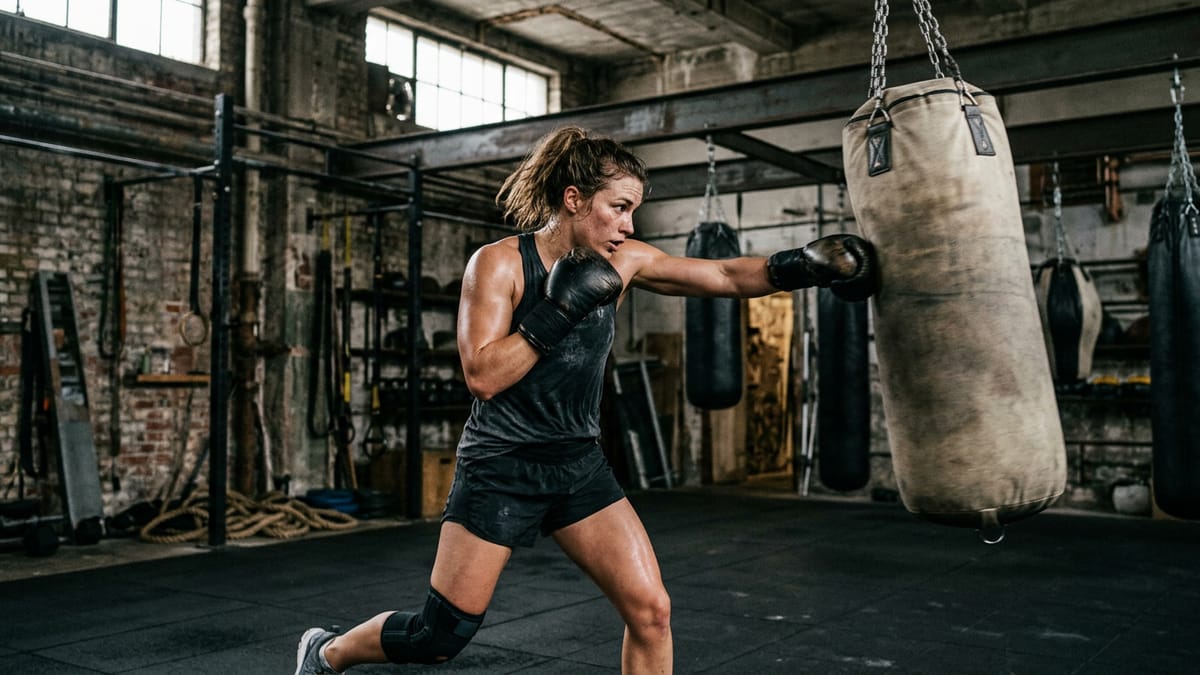
With new dedicated boxing spaces and community fitness centers opening up in neighborhoods everywhere, more people are discovering the physical benefits of striking. You do not need to step into a ring, take a punch, or even buy a gym membership to train like a fighter. Boxing conditioning is one of the most effective ways to build cardiovascular stamina, rotational core strength, and upper-body endurance. By structuring your routine into focused rounds of high-intensity work followed by brief recovery periods, you can create a demanding full-body workout using minimal equipment.
The Biomechanics of Boxing Fitness
Boxing is fundamentally an interval sport. Fighters exert maximum effort through explosive combinations, utilize defensive footwork to recover actively, and then burst into action again. This stop-and-go nature perfectly mirrors high-intensity interval training, forcing your heart rate to adapt rapidly to changing demands.
While it may look like an arm workout, a properly thrown punch recruits muscles from your toes to your knuckles. Power is generated by pushing off the floor with your feet, transferring energy through your calves and thighs, rotating your hips and core, and finally snapping your arm forward. Because of this kinetic chain, a heavy bag workout is actually a lower-body and core routine disguised as an upper-body exercise. The constant rotation heavily targets the obliques, while maintaining a guard position keeps your shoulders under continuous isometric tension.
The Basic 6-Punch System
Before starting a timer, you need to understand the universal numbering system used to call out combinations. Assuming you are in an orthodox stance (left foot forward, right foot back, hands up protecting your face), the numbers correspond to the following strikes. If you are a southpaw (right foot forward), simply reverse the hands.
- 1 - The Jab: A quick, straight punch thrown with your lead (left) hand. It is used to measure distance and set up heavier strikes. Keep your elbow tucked and snap it back to your face immediately.
- 2 - The Cross: A powerful straight punch thrown with your rear (right) hand. Pivot your back foot and rotate your hips forward to drive power through the strike.
- 3 - The Lead Hook: A looping punch thrown with your lead (left) hand, targeting the side of the bag. Keep your elbow bent at a 90-degree angle and pivot your lead foot to snap your hips into the hook.
- 4 - The Rear Hook: The same looping motion, but thrown with your rear (right) hand.
- 5 - The Lead Uppercut: An upward strike with your lead (left) hand, driven by a slight dip in the knees and an upward drive from the legs.
- 6 - The Rear Uppercut: An upward strike with your rear (right) hand, utilizing the same dip and drive mechanics from your back hip.
Equipment and Setup
To execute this routine, you need hand wraps, a pair of boxing gloves (12oz to 16oz is recommended for heavy bag work to protect your knuckles and wrists), and a heavy bag. If you do not have a heavy bag, you can perform the entire routine as a shadow boxing workout. Shadow boxing requires you to actively retract your punches, which is an excellent way to condition your joints and improve your balance.
Keeping track of your rounds manually while wearing boxing gloves is frustrating and disrupts your focus. Setting up a workout timer online before you wrap your hands ensures you stay locked into your combinations rather than looking at a clock. For this routine, we will use a structure of 2-minute work rounds followed by 1-minute rest periods.
The 6-Round Boxing Conditioning Routine
Warm up thoroughly before beginning. Spend five minutes jumping rope to elevate your heart rate and prepare your calves for the bouncing movements of boxing. Follow this with dynamic arm circles, torso twists, and light unweighted squats to prepare your joints.
| Round | Focus | Work Period | Rest Period |
|---|---|---|---|
| 1 | Shadow Boxing & Form | 2 Minutes | 1 Minute |
| 2 | The Fundamentals (1-2) | 2 Minutes | 1 Minute |
| 3 | Power Hooks | 2 Minutes | 1 Minute |
| 4 | Speed and Volume | 2 Minutes | 1 Minute |
| 5 | Inside Fighting (Uppercuts) | 2 Minutes | 1 Minute |
| 6 | The Burnout Finisher | 2 Minutes | Cooldown |
Round 1: Shadow Boxing and Form
Use the first round to calibrate your balance. Do not hit the bag yet. Move around the floor, maintaining your stance. Throw crisp, straight 1-2 combinations in the air. Focus entirely on your footwork. When you move forward, step with your lead foot first. When you move backward, step with your rear foot first. Never cross your feet. Keep your chin tucked and your hands glued to your cheekbones when you are not punching. During the 1-minute rest, focus on deep nasal breathing to bring your heart rate down.
Round 2: The Fundamentals (1-2)
Approach the heavy bag. For these two minutes, you will only throw jabs (1) and crosses (2). Start with a stiff double jab to find your range, followed by a hard cross (1-1-2). Reset your stance after every combination. Do not crowd the bag; you should be just far enough away that your arm fully extends at the exact moment your glove makes contact. If your elbow is deeply bent when you hit the bag with a straight punch, you are standing too close. Keep moving laterally around the bag between combinations.
Round 3: Power Hooks
This round incorporates lateral power. You will throw combinations that end with a hook. Try the 1-2-3 (Jab, Cross, Lead Hook) and the 2-3-2 (Cross, Lead Hook, Cross). Focus on the biomechanics of the hook. Your power comes from the sudden rotation of your core and the pivot of your foot, not from winding your arm backward. Winding up telegraphs your punch and leaves your face exposed. Snap the hook directly from your guard position.
Round 4: Speed and Volume
Drop the emphasis on heavy power and focus entirely on hand speed and aerobic endurance. Stand squarely in front of the bag and throw continuous, light, straight punches (1-2-1-2-1-2) as fast as you can. Aim for eye level. Keep your core tight and let your shoulders do the work. When you need a break, step back, take two deep breaths, step back in, and immediately resume the rapid-fire straight punches. This round will cause significant lactic acid buildup in your shoulders.
Round 5: Inside Fighting (Uppercuts)
Step closer to the bag for inside work. This round focuses on uppercuts and tight hooks. Throw the 5-6-3 (Lead Uppercut, Rear Uppercut, Lead Hook). Because you are close to the bag, keep your elbows tightly pinned to your ribs. Drive the uppercuts by bending your knees and exploding upward. Do not drop your hands to your waist before throwing an uppercut; simply dip your shoulder and drive the punch upward.
Round 6: The Burnout Finisher
The final round is designed to empty your gas tank. Combine everything you have practiced. Move around the bag, throwing 3- to 5-punch combinations. Mix straight punches, hooks, and uppercuts. In the final 30 seconds of the round, plant your feet and throw continuous power shots until the timer signals the end of the workout. Push through the fatigue, but ensure your form does not deteriorate. If you feel your wrists bending upon impact, reduce your power and focus purely on speed and technique.
Safety, Form, and Scaling
Always prioritize joint safety when hitting a heavy bag. Never strike a bag without properly wrapping your hands and wearing adequately padded gloves. Wraps secure the small bones in your hands and stabilize your wrists, preventing sprains upon impact. When throwing straight punches, ensure your fist is horizontal and you are making contact with your first two knuckles. If you feel pain in your wrist or hand, stop immediately, check your wrap job, and evaluate your punching technique.
If you are a beginner, you can scale this workout by extending the rest periods. Using an exercise timer, you might choose to work for 90 seconds and rest for 90 seconds until your cardiovascular fitness improves. Alternatively, perform the entire routine as shadow boxing. Shadow boxing removes the impact from your joints while still providing an elite cardiovascular challenge.
Boxing conditioning places heavy demands on the heart and lungs. If you have preexisting medical conditions, particularly cardiovascular or joint issues, consult a doctor before beginning a high-intensity striking routine. Always respect your body's limits, prioritize proper technique over sheer power, and use your rest intervals effectively.
Frequently asked questions
Do I need a heavy bag for a boxing workout?
No, shadow boxing is a highly effective cardiovascular exercise that requires zero equipment. It allows you to focus purely on speed, footwork, and form without placing impact stress on your joints.
How long should a boxing fitness workout last?
A standard conditioning routine lasts between 20 and 45 minutes. This is typically structured in 2- or 3-minute work rounds with 1 minute of active recovery or rest in between.
What size boxing gloves should I buy for heavy bag work?
For general heavy bag workouts, 12oz to 16oz gloves are recommended. Heavier gloves provide more padding to protect your knuckles and wrists while adding slight resistance for shoulder conditioning.
How often should I do boxing conditioning?
Two to three times a week is an excellent frequency for boxing conditioning. This schedule provides intense cardiovascular benefits while allowing your muscles and joints enough time to recover between sessions.
Use this timer
Start the Conditioning: 2 min / 1 min timer — 120s work / 60s rest × 6 rounds. It runs in your browser with sound cues, and there is nothing to install.